What the study found
The study found that canonical K-type boundary layer transition can be described as an organized sequence of temporal and spatial symmetry breaking, rather than as unstructured noise. The authors identify a periodic, spanwise-symmetric fundamental harmonic response to the Tollmien–Schlichting wave before the skin-friction maximum, followed later by quasi-periodic, aperiodic, and anti-symmetric structures.
Why the authors say this matters
The authors conclude that this supports viewing laminar-to-turbulent transition as a sequence of symmetry-breaking events. They suggest the dominant space-time modes route energy from harmonic flow into broadband turbulence.
What the researchers tested
The researchers analyzed canonical K-type boundary layer transition and used symmetry-decomposed spectral and space-time proper orthogonal modes. They also derived inter-modal and inter-symmetry energy budgets from symmetry-decomposed Navier–Stokes equations.
What worked and what didn't
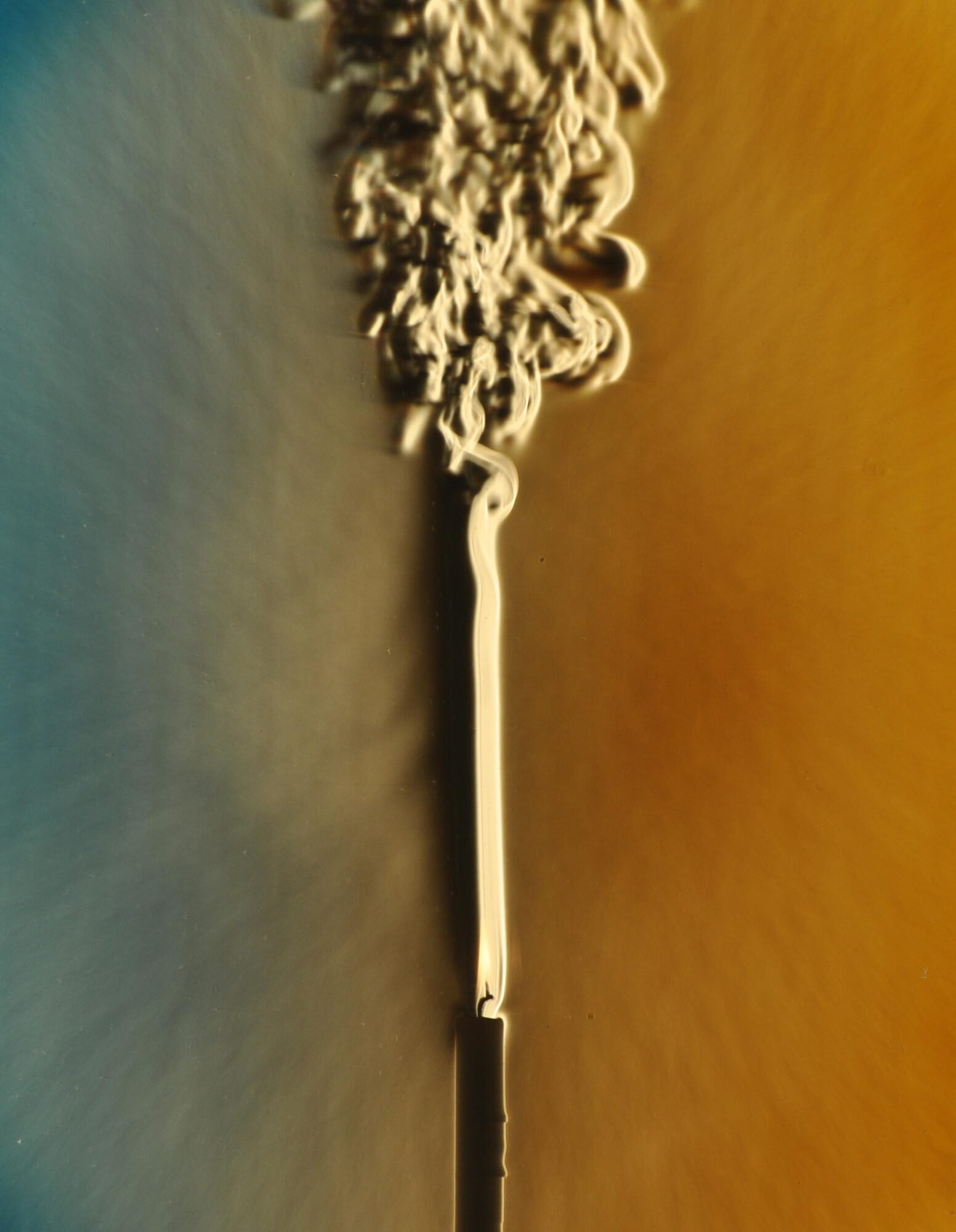
Before the skin-friction maximum, the fundamental harmonic response was spatially compact, produced hairpin packets, and remained fully harmonic despite a turbulence-like appearance. After that point, a regime change occurred: quasi-periodic and aperiodic structures emerged, then anti-symmetric structures developed even without anti-symmetric inputs, and broadband dynamics grew only once inter-modal transfer became active.
What to keep in mind
The abstract describes one canonical K-type boundary layer transition case, so the scope is specific. It does not provide additional limitations beyond the stated analysis framework.
Key points
- Boundary layer transition is described as organized temporal and spatial symmetry breaking.
- Before the skin-friction maximum, the flow followed a periodic, spanwise-symmetric fundamental harmonic response.
- The fundamental harmonic response produced hairpin packets but stayed fully harmonic.
- After a regime change, quasi-periodic, aperiodic, and then anti-symmetric structures appeared.
- Energy budgets showed directed transfer from harmonic flow into broadband fluctuations.
Disclosure
- Research title:
- Boundary layer transition follows symmetry-breaking energy pathways
- Authors:
- Cong Lin, Oliver T. Schmidt
- Institutions:
- University of California San Diego, University of California San Diego, University of San Diego, University of San Diego
- Publication date:
- 2026-04-21
- OpenAlex record:
- View
- Image credit:
- Gary Settles, Wikimedia Commons, CC BY-SA 3.0
Get the weekly research newsletter
Stay current with scholarly research without reading academic papers — one filtered digest, every Friday.