Author: editor@focalinterest.com

  • Unit-cell modulation triggers topological phase transitions in photonic Lieb lattices

    What the study found

    The study found that changing the unit cell of a photonic Lieb lattice, a structured light-guiding material, can induce a hierarchy of topological phases. These phases include first-order Chern phases and second-order dipole and quadrupole phases under broken time-reversal symmetry.

    Why the authors say this matters

    The authors conclude that this may broaden sublattice engineering design for topological phase manipulation. They also suggest it may enable multifunctional disorder-resistant waveguides and integrated photonic circuits for information communication.

    What the researchers tested

    The researchers carried out a theoretical study of gyromagnetic photonic crystals. They examined how relaxing a spatial symmetry of the unit cell affects the appearance and transition of edge and corner states.

    What worked and what didn't

    They report that both edge states and corner states can be established and made to transition between phases by modulating the unit cell. Bandgap closures marked the phase boundaries. The abstract does not describe any cases where the approach failed.

    What to keep in mind

    This summary is based on a theoretical paper, not an experimental demonstration. The abstract does not provide quantitative results, device performance data, or specific limitations beyond the stated scope of gyromagnetic photonic crystals.

    • Modulating the unit cell can induce multiple topological phases in a photonic Lieb lattice.
    • The phases reported include first-order Chern, second-order dipole, and quadrupole phases.
    • Edge states and corner states can both be established and transitioned by relaxing a spatial symmetry.
    • Bandgap closures mark the phase boundaries in the reported transitions.
    • The authors say the results may broaden sublattice engineering for topological phase manipulation.
  • Digital tools support preservation of Yi wedding customs

    What the study found

    The study found that digital technologies can support the preservation of Yi wedding customs. It also reports that these tools can improve the accuracy, interactivity, and educational value of cultural documentation.

    Why the authors say this matters

    The authors suggest this matters for the sustainable preservation of intangible cultural heritage, which means living traditions and cultural practices. They also state that the findings align with the United Nations Sustainable Development Goals and offer theoretical insights and practical guidance.

    What the researchers tested

    The researchers used fieldwork in Meigu and Zhaojue counties to document the Kezhi debate and wedding rituals. They evaluated 3D motion capture, virtual reality (VR), and digital archives as tools for cultural documentation, and they proposed a Technology–Institution–Agency model.

    What worked and what didn't

    The study says digital technologies can support preservation of Yi wedding customs, strengthen cultural identity among Yi youth, improve cultural education outcomes, and attract external visitors. It also notes risks of cultural simplification and misrepresentation.

    What to keep in mind

    The summary does not provide detailed measures, sample sizes, or comparative performance data for the digital tools. The abstract also notes risks of simplification and misrepresentation, but it does not describe how strongly these risks affected the project.

    • The study focuses on the digital transformation of intangible cultural heritage using Yi wedding customs in China as a case study.
    • 3D motion capture, virtual reality, and digital archives were assessed for their value in cultural documentation.
    • The authors propose a Technology–Institution–Agency model linking digital innovation, governance, and cultural bearer participation.
    • The findings indicate digital technologies can help preserve Yi wedding customs and improve cultural education outcomes.
    • The abstract notes risks of cultural simplification and misrepresentation.
  • Finite element scheme achieves optimal error bounds

    What the study found

    The study found an error analysis for a finite element discretization of a corotational harmonic map heat flow problem. Under the assumption of smooth solutions, the authors report optimal order discretization error bounds.

    Why the authors say this matters

    The authors indicate that the analysis is relevant because it shows discrete stability and control of linearization error through a discrete energy estimate and a convexity property. They also suggest the numerical results support the theoretical analysis.

    What the researchers tested

    The researchers studied the harmonic map heat flow problem in the corotational case. They used an H1-conforming finite element method in space together with a semi-implicit Euler time-stepping method, which gives a linear problem at each time step.

    What worked and what didn't

    The discretization method produced optimal order error bounds in the smooth-solution regime described in the abstract. The paper also states that numerical results validated the theoretical findings.

    What to keep in mind

    The analysis is restricted to smooth solutions of the continuous problem. The abstract does not describe any limitations beyond this scope.

    • The paper analyzes a finite element discretization for a corotational harmonic map heat flow problem.
    • An H1-conforming finite element method and a semi-implicit Euler time-stepping scheme were used.
    • The semi-implicit Euler method leads to a linear problem at each time step.
    • The authors report optimal order discretization error bounds for smooth solutions.
    • A discrete energy estimate and a convexity property are key parts of the analysis.
    • Numerical results are said to validate the theory.
  • Fibrosis-associated peptides identified as therapeutic targets in lung fibrosis

    What the study found

    The study found a diverse set of fibrosis-associated peptides in the major histocompatibility complex class I immunopeptidome, which is the collection of peptides presented by MHC class I molecules, in human idiopathic pulmonary fibrosis and bleomycin-treated mice. It also found that three candidate peptides reduced fibrosis progression in mice, and that one peptide could trigger human cytotoxic T lymphocytes to kill fibrosis-associated human cells.

    Why the authors say this matters

    The authors conclude that immunopeptidome profiling provides a robust platform for discovering translatable antifibrotic immunotherapies. The findings indicate that altered peptide presentation in fibrosis may offer therapeutic targets.

    What the researchers tested

    The researchers characterized MHC class I immunopeptidomes from fibrotic foci in human idiopathic pulmonary fibrosis lung explants and from bleomycin-treated mice. They also used parallel profiling in bleomycin-induced pulmonary fibrosis in mice to computationally prioritize therapeutic targets, then tested candidate peptides through therapeutic vaccination and human cell killing assays.

    What worked and what didn't

    Therapeutic vaccination with three candidate peptides, MAF116–124, APBB270–78, and TNS3119–127, effectively mitigated fibrosis progression in bleomycin-treated mice. In a separate finding, MAF116–124 elicited specific human cytotoxic T lymphocytes that lysed human idiopathic pulmonary fibrosis-derived myofibroblasts and M2-like macrophages. The abstract does not report unsuccessful candidate peptides or negative results in detail.

    What to keep in mind

    The findings come from human lung explants, bleomycin-treated mice, and in vitro human cell assays, so the abstract describes evidence from these systems only. The abstract does not provide detailed limitations, safety data, or long-term outcomes.

    • Fibrosis-associated peptides were identified in the MHC class I immunopeptidomes of human and mouse lung fibrosis samples.
    • Three candidate peptides reduced fibrosis progression in bleomycin-treated mice after therapeutic vaccination.
    • The peptide MAF116–124 triggered human cytotoxic T lymphocytes that killed fibrosis-derived myofibroblasts and M2-like macrophages.
    • The authors say immunopeptidome profiling may be a platform for discovering antifibrotic immunotherapies.
  • Italy’s risk-factor burden changed unevenly across regions and sexes

    What the study found

    The study found that disease burden attributable to risk factors in Italy improved overall from 1990 to 2023, but the changes were not the same across regions or between males and females. Metabolic risks are risk factors such as those related to body metabolism, and their burden showed different patterns by sex and place, while behavioural risks decreased across all macro regions.

    Why the authors say this matters

    The authors conclude that the remaining regional and sex differences mean stronger tobacco control, gender-sensitive interventions on metabolic risks, and attention to social determinants of health are needed. The study suggests these issues matter for health policy in Italy.

    What the researchers tested

    The researchers used estimates from the Global Burden of Diseases, Injuries, and Risk Factors Study 2023 to examine risk-factor-attributable disease burden in Italy from 1990 to 2023. They assessed disability-adjusted life years (DALYs, a measure that combines years of life lost and years lived with disability) across five Italian macro regions, using all-age and age-standardised rates per 100,000 population, and tested correlations with the Socio-demographic Index (SDI).

    What worked and what didn't

    Metabolic risks in males declined nationally, but rose in the South and stayed stable in the Islands. In females, metabolic risks were stable overall, but increased in the South and Islands; behavioural risks decreased across all macro regions in both sexes. DALYs from metabolic risks were strongly and inversely correlated with SDI in both sexes, while behavioural risks were negatively correlated with SDI only in males.

    What to keep in mind

    The abstract does not describe detailed limitations beyond noting that the analysis is based on Global Burden of Disease estimates. The study covers Italy from 1990 to 2023 and compares five macro regions, so the findings are limited to that setting and time period.

    • Overall burden attributable to risk factors improved in Italy from 1990 to 2023.
    • Metabolic risks declined nationally in males but rose in southern Italy and stayed stable in the Islands.
    • Metabolic risks were stable overall in females, but increased in the South and Islands.
    • Behavioural risks decreased across all macro regions in both sexes.
    • Metabolic-risk DALYs were strongly and inversely correlated with SDI in both sexes.
  • Free-bound transitions affect warm dense matter temperature measurements

    What the study found

    The study found that free-bound transitions, in which free electrons are de-excited into thermally unoccupied bound states while transferring momentum and energy to a scattered x-ray photon, are a feature of warm dense matter. The authors report that these transitions vanish in the limits of cold and hot temperatures.

    Why the authors say this matters

    The authors say this matters because warm dense matter experiments are often interpreted through models with systematic errors that are difficult to quantify. The study suggests that including free-bound transitions is required to obtain a physically consistent temperature from the Chihara decomposition, which the authors present as an important step for precisely characterizing warm dense matter.

    What the researchers tested

    The researchers analyzed recent X-ray Thomson Scattering experiments on warm dense matter at the National Ignition Facility and the Linac Coherent Light Source. They tested whether adding free-bound transitions to the analysis changes the temperature inferred from the Chihara decomposition, and they compared that interpretation with a recently developed model-free thermometry technique.

    What worked and what didn't

    Including free-bound transitions in the analysis was required to obtain a physically consistent temperature from the Chihara decomposition. The interpretation was corroborated by agreement with the model-free thermometry technique. The abstract does not describe any specific analysis that worked without these transitions beyond noting that their inclusion was necessary.

    What to keep in mind

    The abstract does not provide quantitative details about the size of the effect or the experimental conditions beyond the named facilities and technique. It also does not describe limitations of the study in the available summary.

    • Free-bound transitions are described as a feature of warm dense matter.
    • These transitions vanish in the limits of cold and hot temperatures.
    • Including them was required to get a physically consistent temperature from the Chihara decomposition.
    • The interpretation matched a model-free thermometry technique.
    • The work was applied to X-ray Thomson Scattering experiments at the National Ignition Facility and the Linac Coherent Light Source.
  • Troponin T and I differ after bypass surgery and affect infarction criteria

    What the study found

    Cardiac troponin T and cardiac troponin I, two heart muscle injury biomarkers, showed different postoperative levels after coronary artery bypass graft surgery. These differences affected how often patients met existing definitions of perioperative myocardial infarction, meaning heart injury around the time of surgery.

    Why the authors say this matters

    The authors conclude that the different behavior of cardiac troponin T and I has an impact on current criteria for perioperative myocardial infarction. The study suggests that the biomarker used may change whether a patient meets guideline-based thresholds.

    What the researchers tested

    The researchers studied adults older than 18 years who underwent isolated coronary artery bypass graft surgery. They measured cardiac troponin T and I in the same patients using the same blood samples, and included only patients with patent bypass grafts on postoperative computed tomography and no at least 10% decrease in left ventricular ejection fraction, indicating an uneventful postoperative course. They then applied perioperative myocardial infarction criteria from the Universal Definition of Myocardial Infarction, Academic Research Consortium-2, and VISION.

    What worked and what didn't

    The study included 258 patients with a median age of 69 years. Median peak postoperative troponin values were 349 ng/L for cardiac troponin T and 1517 ng/L for cardiac troponin I, with peaks most often seen on the first postoperative day. The biomarker cutoffs were exceeded more often for cardiac troponin I than for cardiac troponin T under all three definitions; when echocardiogram and electrocardiogram criteria were also included, the differences became smaller but remained.

    What to keep in mind

    The summary does not describe limitations beyond the study population and design. The findings apply to patients with isolated coronary artery bypass graft surgery and an uneventful postoperative course as defined in the study.

    • Cardiac troponin T and I had different postoperative concentrations after coronary artery bypass graft surgery.
    • Troponin I exceeded perioperative myocardial infarction biomarker cutoffs more often than troponin T.
    • The comparison used the same patients and the same blood samples for both biomarkers.
    • The study applied criteria from the Universal Definition of Myocardial Infarction, Academic Research Consortium-2, and VISION.
    • Differences between troponin T and I were smaller when echocardiogram and ECG criteria were added.
  • Subnormalisers of semisimple elements in finite groups are determined

    What the study found

    The study determines the subnormalisers of semisimple elements of prime power order in finite quasi-simple groups of Lie type. It also determines the maximal overgroups of normalisers of Sylow tori, where a Sylow torus is a maximal torus tied to a prime divisor condition in groups of Lie type.

    Why the authors say this matters

    The authors say the work is motivated by the recent character correspondence conjecture of Moretó and Rizo. They also state that it is motivated by the question of whether quasi-semiregular elements exist in finite permutation groups.

    What the researchers tested

    The paper studies finite quasi-simple groups of Lie type and examines semisimple elements of prime power order. The authors determine subnormalisers and investigate maximal overgroups of normalisers of Sylow tori.

    What worked and what didn't

    The abstract states that the subnormalisers are determined for the elements under study. It also states that the maximal overgroups of normalisers of Sylow tori are determined; it does not describe any unsuccessful cases or exceptions.

    What to keep in mind

    The available summary is limited to the abstract, so no detailed methods, examples, or exceptions are provided. The abstract does not state broader consequences beyond the motivating questions.

    • Subnormalisers of semisimple elements of prime power order are determined.
    • The setting is finite quasi-simple groups of Lie type.
    • Maximal overgroups of normalisers of Sylow tori are also determined.
    • The work is motivated by a character correspondence conjecture of Moretó and Rizo.
    • The abstract also mentions quasi-semiregular elements in finite permutation groups as motivation.
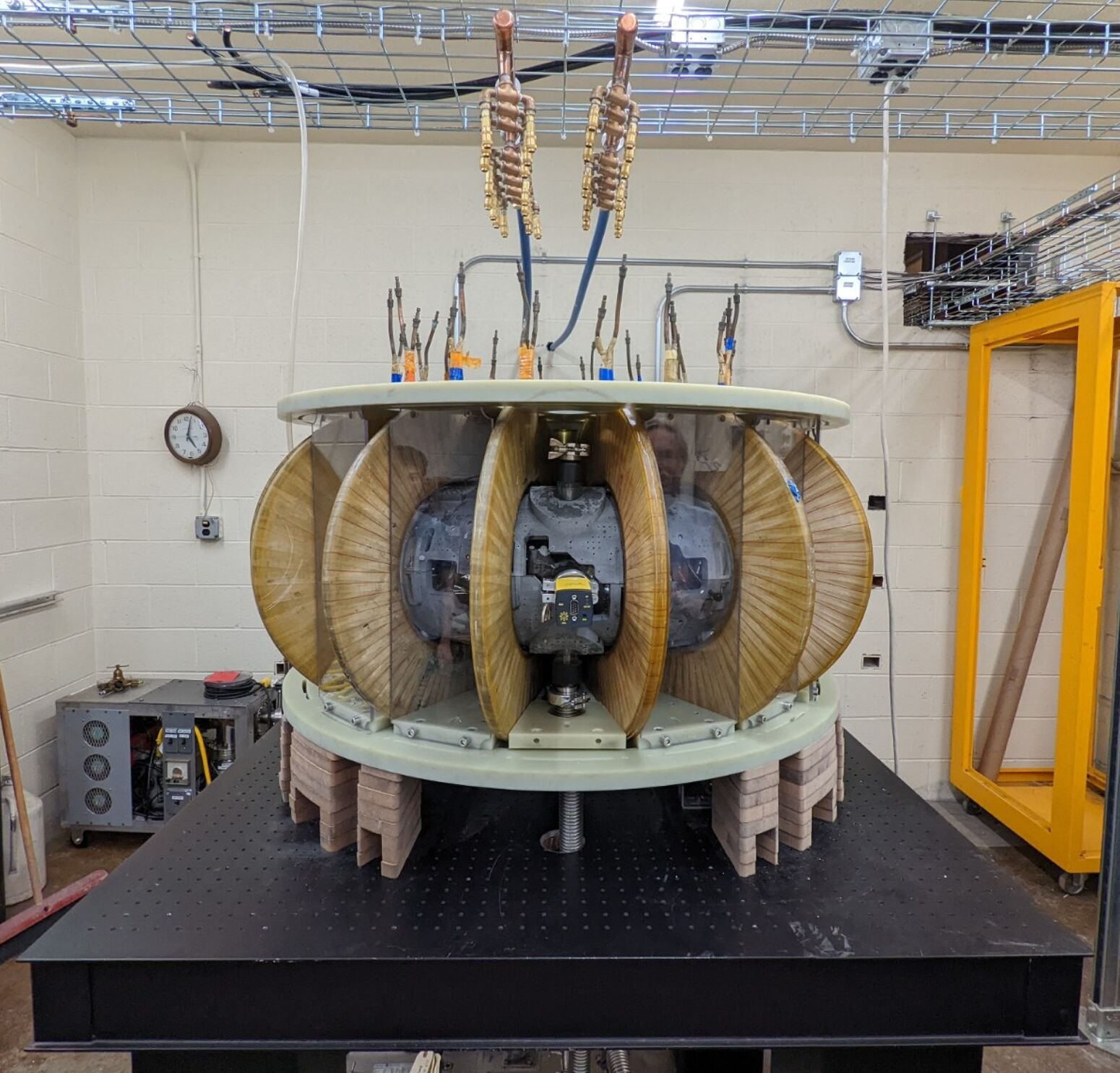
  • Helios design uses optimized planar coil stellarator equilibrium

    Helios design uses optimized planar coil stellarator equilibrium

    What the study found

    The paper reports an optimized preconceptual design for Helios, a fusion power plant based on a planar coil stellarator architecture. The resulting design is described as a two-field-period, low aspect ratio, quasi-axisymmetric stellarator with a tokamak-like X-point divertor.

    Why the authors say this matters

    The authors conclude that the design satisfies the high-level requirements they set for a fusion power plant, including confinement of fusion-born alpha particles, nonlinear stability at high pressure, and a feasible divertor. They also say the optimization process promises further improvements with continued work.

    What the researchers tested

    The researchers developed single-stage optimization tools to compute free-boundary equilibria, meaning plasma balance configurations shaped by planar coil sets. They also implemented optimization functions aimed at equilibria that confine alpha particles, remain nonlinearly stable at high pressure, and include a feasible divertor.

    What worked and what didn't

    The effort yielded an attractive preconceptual design for Helios, according to the abstract. The paper says the equilibrium properties satisfy all of the stated high-level requirements, but it does not provide detailed quantitative comparisons or note specific failures in the abstract.

    What to keep in mind

    This summary is based only on the abstract, so technical details are limited. The work describes a preconceptual design and optimization process; the abstract does not describe experimental validation, cost, or engineering constraints beyond the stated equilibrium requirements.

    • Helios is presented as a fusion power plant design based on planar coil stellarator architecture.
    • The optimized design is two-field-period, low aspect ratio, and quasi-axisymmetric.
    • The design includes a tokamak-like X-point divertor.
    • The optimization targeted alpha-particle confinement, nonlinear stability at high pressure, and a feasible divertor.
    • The abstract says the resulting equilibrium properties satisfy the stated high-level requirements.
  • Reinforcement learning improved quantum error correction stability

    Reinforcement learning improved quantum error correction stability

    What the study found

    The study found that reinforcement learning, a machine-learning method that learns from feedback, can be combined with quantum error correction so a quantum computer can continuously self-calibrate during computation. The authors report improved stability and record logical error performance in their experiments and simulations.

    Why the authors say this matters

    The authors conclude that this approach addresses the problem of having to stop a quantum computation for recalibration, which they say is incompatible with the long runtimes expected for future quantum algorithms. They suggest this enables a quantum computer that learns from its errors and keeps computing.

    What the researchers tested

    The researchers unified calibration with computation by using error-detection events from quantum error correction as a learning signal for a reinforcement learning agent. They tested the framework on a Willow superconducting processor and also ran numerical simulations of large codes with tens of thousands of control parameters.

    What worked and what didn't

    In experiments, the framework improved the logical stability of the surface code 3.5-fold against injected drift. The authors report record performance for the surface and colour codes, with average logical error per cycle of 7.72(9) × 10−4 and 8.19(14) × 10−3, respectively. The simulations indicate that the optimization speed is independent of system size.

    What to keep in mind

    The abstract does not describe detailed limitations beyond the stated scope of the experiments and simulations. The reported results are specific to the tested processor, the surface and colour codes, and the simulated large-code setting.

    • Reinforcement learning was used to continuously steer control parameters during quantum error correction.
    • The method repurposed error-detection events as a learning signal.
    • On a Willow superconducting processor, the surface code’s logical stability improved 3.5-fold against injected drift.
    • The authors report record logical error rates for the surface and colour codes.
    • Simulations with tens of thousands of control parameters showed optimization speed independent of system size.