Author: editor@focalinterest.com

  • Extremal signed complete graphs with a K2,2-minor-free negative subgraph

    What the study found

    The authors characterize the extremal signed complete graphs that achieve the maximum and second maximum index, where the negative-edge-induced subgraph is K2,2-minor free. Here, a signed complete graph means a complete graph with edges labeled positive or negative, and the negative-edge-induced subgraph is the subgraph formed by the negative edges.

    Why the authors say this matters

    The abstract says that characterizing the extremum problem of the index of a signed complete graph is a concern in signed graphs. The study suggests this result helps address that extremal problem under the condition that the negative-edge-induced subgraph is K2,2-minor free.

    What the researchers tested

    The researchers studied a signed complete graph Γ = (K_n, H^-), where H^- is the negative-edge-induced subgraph. They examined the case in which H is a spanning subgraph of K_n that is K2,2-minor free, and they analyzed which signed complete graphs give the largest and second largest index.

    What worked and what didn't

    The abstract states that the extremal signed complete graphs achieving the maximum index were characterized. It also states that the extremal graphs achieving the second maximum index were characterized. No additional specific graph forms or comparisons are given in the abstract.

    What to keep in mind

    The available summary does not describe the exact characterization results or the mathematical form of the index. It also does not state limitations, examples, or applications beyond the K2,2-minor-free setting.

    • The paper studies signed complete graphs with negative edges forming a K2,2-minor-free subgraph.
    • It characterizes the graphs with the maximum index in this setting.
    • It also characterizes the graphs with the second maximum index.
    • The abstract frames this as part of an extremum problem in signed graphs.
  • Fourier bounds for Kakeya sets in finite fields

    What the study found

    The study found that a Kakeya set in a vector space over a finite field supports a probability measure whose Fourier transform is bounded for all non-zero frequencies. The authors also report that this bound is sharp in all dimensions at least 2.

    Why the authors say this matters

    The authors say this gives a Fourier analytic proof that a Kakeya set in dimension 2 must have size at least the stated lower bound, which they describe as asymptotically sharp. The study also suggests analogous results for sets containing planes in specified orientations.

    What the researchers tested

    The paper studies Kakeya sets in vector spaces over finite fields using Fourier analysis. It also considers sets containing planes in a given set of orientations.

    What worked and what didn't

    The authors prove the Fourier transform bound for non-zero frequencies and show that it cannot be improved in dimensions 2 and above. They also obtain an analogous result for sets containing planes in specified orientations.

    What to keep in mind

    The abstract does not provide the exact numerical bounds, so those details are not included here. It also does not describe limitations beyond the stated scope over finite fields and dimensions at least 2.

    • Kakeya sets over finite fields support a probability measure with a bounded Fourier transform at non-zero frequencies.
    • The bound is reported to be sharp in all dimensions at least 2.
    • The authors say this yields a Fourier analytic proof of a lower bound on the size of two-dimensional Kakeya sets.
    • The abstract also mentions analogous results for sets containing planes in specified orientations.
  • Glass-forming liquid crystal mixtures selectively reflect different colors

    Glass-forming liquid crystal mixtures selectively reflect different colors

    What the study found

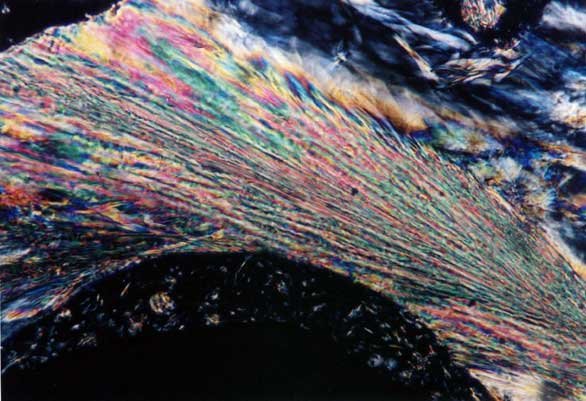
    The study found that glass-forming ternary liquid crystalline mixtures can selectively reflect different colors of light depending on their phase and thermal history. In the glassy state, the mixtures reflect blue light, while in the smectic C* phase they reflect either green or red light.

    Why the authors say this matters

    The abstract does not explicitly state broader implications beyond the observation itself. The findings indicate that temperature treatment can influence which color is reflected by these mixtures.

    What the researchers tested

    The researchers examined ternary liquid crystalline mixtures that form glassy states and show a smectic C* phase, a liquid-crystal phase with tilted molecular order. They compared how the reflected color changed with cooling, heating, and different temperature-change rates.

    What worked and what didn't

    Both mixtures reflected blue light in the glassy state. In the smectic C* phase, the reflected color varied: the mixtures reflected either green or red light depending on whether the sample was cooled or heated, or on how quickly the temperature changed.

    What to keep in mind

    The abstract gives only a brief summary, so details about the mixtures, measurements, and experimental conditions are not provided here. Limitations are not described in the available summary.

    • The mixtures reflect blue light in the glassy state.
    • In the smectic C* phase, they reflect either green or red light.
    • The reflected color depends on temperature treatment, including cooling, heating, and rate of temperature change.
    • The abstract describes ternary liquid crystalline mixtures and does not provide further experimental detail.
  • Review connects physical inner products to gravitational Hilbert spaces

    What the study found

    The authors conclude that in gravity, a physical Hilbert space can be defined either by imposing constraint equations, such as the Wheeler-DeWitt equation, or by identifying equivalent wavefunctions, and that these two viewpoints are connected by the inner product. They also state that group averaging gives the correct physical inner product.

    Why the authors say this matters

    The study suggests that these ideas help clarify the Hilbert space interpretation of gravitational path integrals and related canonical gravity constructions. The authors also present the BRST/BFV formalism as a systematic way to build physically equivalent inner products.

    What the researchers tested

    The article reviews and extends ideas from canonical gravity and connects them to the sum-over-histories approach. It uses one-dimensional, or mini-superspace, models as the simplest setting, and discusses gauge-fixing, group averaging, the Klein-Gordon inner product, and BRST/BFV methods.

    What worked and what didn't

    The authors say group averaging constructs the correct physical inner product. They report that the Klein-Gordon inner product is not positive-definite and explain this as arising from a bad gauge choice, although it agrees with group averaging when that problem is absent.

    What to keep in mind

    The discussion is framed around conceptual issues in gravity and uses simple one-dimensional models to illustrate them. The abstract also notes that the article discusses semi-classical approximation and non-perturbative gravitational effects, but it does not give detailed results for those topics.

    • A physical Hilbert space in gravity can be defined through constraints or through equivalence relations between wavefunctions.
    • The inner product connects those two ways of defining the physical Hilbert space.
    • The authors advocate group averaging as the correct way to construct the physical inner product.
    • The Klein-Gordon inner product is described as not positive-definite because of a bad gauge choice.
    • BRST/BFV formalism is presented as a systematic framework for equivalent inner products.
  • Multifold quantum degeneracies can produce bounded numbers of Weyl points

    What the study found

    The study finds an upper bound on the number of Weyl points, which are generic twofold degeneracy points, that can arise when a multifold degeneracy point splits in a quantum system. The authors also relate this problem to singularities in the space of complex matrices.

    Why the authors say this matters

    The authors say the work helps connect physics and mathematics by using singularity theory and local algebraic geometry to study energy degeneracies in quantum systems. They also state that the paper surveys examples from quantum systems and condensed-matter physics to support this bridge between the two fields.

    What the researchers tested

    The researchers studied parameter-dependent quantum systems in which three or more energy levels coincide at a point, called a multifold degeneracy. They described the geometric degeneracy variety in the space of complex matrices and computed its multiplicity at certain singular points, along with the multiplicity of holomorphic map germs with respect to this variety.

    What worked and what didn't

    The approach produced an upper bound for the number of Weyl points born from a multifold degeneracy point. The abstract does not report a negative result or a comparison showing that another method failed.

    What to keep in mind

    The abstract does not give the actual upper bound value in the summary provided. It also does not state experimental data, specific systems analyzed in detail, or limitations beyond the scope of the mathematical framework described.

    • A multifold degeneracy point can split into multiple Weyl points under a generic perturbation.
    • The authors provide an upper bound on how many Weyl points can arise from that splitting.
    • Their calculation uses the degeneracy variety in the space of complex matrices.
    • They compute multiplicities at singular points and for holomorphic map germs.
    • The paper aims to connect quantum physics with singularity theory and local algebraic geometry.
  • Noise-canceling method computes finite-temperature elastic constants

    What the study found

    The study shows a way to compute elastic constants, which are measures of how a material resists deformation, at finite temperature with favorable thermal noise. The approach works for both thermally ordered and disordered systems.

    Why the authors say this matters

    The authors say elastic constants are central material properties and note that finite-temperature calculations often suffer from poor signal-to-noise ratios, strong anharmonic effects, or the need for second-order spatial derivatives. The study suggests their method addresses these difficulties.

    What the researchers tested

    The researchers generalized a noise-cancellation method first developed for piezoelectric coupling coefficients, which relate strain to electric polarization. They applied a slight strain to an equilibrated solid and ran simulations of the strained and unstrained, or oppositely strained, reference systems using identical thermostatting schemes.

    What worked and what didn't

    Theoretical analysis and generic one-dimensional models showed that stress differences can be evaluated in a way that yields elastic constants with favorable thermal noise. The authors then applied the approach to crystalline argon, ordered silicon, amorphous silicon, poly(methyl methacrylate), and cellulose derivatives.

    What to keep in mind

    The abstract does not give quantitative performance details, so the size of the improvement is not stated in the available summary. It also does not describe specific failures, comparison baselines, or implementation limits beyond the systems listed.

    • The paper presents a method for computing elastic constants at finite temperature.
    • The method uses noise cancellation by comparing strained and reference simulations with identical thermostatting.
    • It is reported to work for both thermally ordered and disordered systems.
    • The approach was demonstrated theoretically, in one-dimensional models, and across several materials.
    • The abstract does not report quantitative error reduction or detailed limitations.
  • Quasi-markets need supportive institutions to foster innovation

    What the study found

    The study argues that welfare quasi-markets can support innovation only when they are backed by a suitable institutional framework. In the Swedish cases discussed, competition and profit incentives were important but were not enough on their own to sustain innovation in school and nursing home services.

    Why the authors say this matters

    The authors suggest that quasi-markets in welfare services can unlock their innovation potential only if institutions help users make knowledgeable choices and push providers to compete in ways that match user preferences. The study indicates that this is relevant for entrepreneurship and innovation in welfare service provision.

    What the researchers tested

    The article examines welfare quasi-markets, which are markets in publicly provided or publicly funded services. The authors analyze the development of quasi-markets in primary and secondary education and in elderly care nursing homes in Sweden.

    What worked and what didn't

    The findings indicate that competition and profit incentives mattered, but they were insufficient as catalysts for sustained innovation in these quasi-market settings. The authors conclude that epistemically supportive institutions were also needed to enable informed user choice and innovation aligned with user preferences.

    What to keep in mind

    The abstract presents Sweden as the main source of evidence, focusing on schools and nursing homes. It does not describe the detailed methods, specific measures, or any limitations beyond the claim that the Swedish experience illustrates the broader argument.

    • The article argues that welfare quasi-markets need a suitable institutional framework to support innovation.
    • In Sweden, competition and profit incentives were not enough to sustain innovation on their own.
    • The analysis covers primary and secondary education and elderly care nursing homes.
    • The authors say users need institutions that help them make knowledgeable choices.
    • The paper concludes that providers should be encouraged to innovate in ways that fit user preferences.
  • New necessary condition for tilings of the symmetric group

    What the study found

    The authors established a new necessary condition for a tiling of the symmetric group by the identity and all transpositions. They also studied tilings by the set of all transpositions and were led to conjecture that neither set tiles for any value of n.

    Why the authors say this matters

    The authors state that their condition generalizes a result of Rothaus and Thompson and a result of Nomura. The findings indicate a broader constraint on when these symmetric-group tilings can exist.

    What the researchers tested

    The researchers studied tilings of a group, meaning that every element must be uniquely written as a product of one element from each of two subsets. In this paper, they focused on the symmetric group and on subsets made from the identity and transpositions, which are swaps of two elements.

    What worked and what didn't

    They showed that a tiling of the symmetric group by the identity and all transpositions must satisfy a partition-transitivity condition with respect to certain partitions of n. This extends earlier nonexistence results, including the case where n is divisible by a prime number at least 5. They also report that their study of tilings by all transpositions led them to conjecture that neither of the two proposed tilings exists for any n.

    What to keep in mind

    The abstract gives a necessary condition and a conjecture, not a full classification. It does not provide the detailed proofs or further limitations in the available summary.

    • A new necessary condition was found for tilings of the symmetric group by the identity and all transpositions.
    • The condition is partition-transitivity with respect to certain partitions of n.
    • The result generalizes earlier work by Rothaus and Thompson and by Nomura.
    • The authors also studied tilings by all transpositions and conjecture that neither proposed tiling exists for any n.
    • The abstract states an earlier nonexistence result when n is divisible by a prime number at least 5.
  • Adjoint QCD2 can exhibit supersymmetry at special fermion masses

    What the study found

    The study finds that adjoint QCD2, a 1+1-dimensional SU(N) gauge theory with an adjoint Majorana fermion, has supersymmetry at a specific fermion mass. The authors also identify related generalizations where a supersymmetric massive sector can appear, and in some cases both the massive and gapless sectors are supersymmetric.

    Why the authors say this matters

    The authors conclude that constructing a gauge-invariant, Lorentz-covariant supercurrent gives a deeper understanding of how the supersymmetry works. They also suggest that the generalized models show how supersymmetry can appear in both massive and non-supersymmetric conformal field theory sectors, and in some cases in both sectors together.

    What the researchers tested

    The researchers constructed the gauge-invariant, Lorentz-covariant supercurrent j_μ^A for adjoint QCD2 and examined how its conservation depends on a quantum anomaly. They then extended the construction to a class of gauge theories with an adjoint Majorana fermion of an appropriate mass plus additional massless fermions, allowing the gauge group to be more general than SU(N).

    What worked and what didn't

    For adjoint QCD2, supersymmetry appears at fermion mass sqrt(g^2N/2π). In the generalized models, the authors report that there is generally a supersymmetric massive sector and a non-supersymmetric conformal field theory sector, but they also identify cases where both sectors are supersymmetric; one example is SU(N) gauge theory with three adjoint Majorana fermions, two massless and one with mass sqrt(3g^2N/2π).

    What to keep in mind

    The abstract does not describe experimental data, numerical tests, or the full derivation, so only the stated theoretical results can be summarized here. It also does not give limitations beyond the fact that the supersymmetry appears at specific mass values and in specific classes of models.

    • Adjoint QCD2 has supersymmetry at fermion mass sqrt(g^2N/2π).
    • The authors construct a gauge-invariant, Lorentz-covariant supercurrent.
    • The supercurrent conservation relies on a quantum anomaly.
    • Generalized models can have a supersymmetric massive sector and a non-supersymmetric conformal field theory sector.
    • A fully supersymmetric gapless example is SU(N) gauge theory with three adjoint Majorana fermions.
  • Hybrid scaling describes overlapping classical and quantum Yang-Lee behavior

    What the study found

    The study found that the overlapping critical region between classical and quantum Yang-Lee edge singularities can be described by a hybrid scaling mechanism. In this picture, scaling functions from both critical regimes apply at the same time and must satisfy a constraint relation.

    Why the authors say this matters

    The authors conclude that this provides a concrete realization of quantum-to-classical crossover in a non-Hermitian Yang-Lee edge singularity system. They also say the framework may allow quantum critical information to be extracted from finite-temperature classical measurements.

    What the researchers tested

    The researchers applied established renormalization group crossover theory to a non-Hermitian Yang-Lee edge singularity system. They used the transverse Ising chain in an imaginary longitudinal field as a model, and examined 0D and 1D quantum and classical Yang-Lee edge singularity phase transitions at zero and finite temperature.

    What worked and what didn't

    They systematically investigated scaling functions in the critical regions of 0D and 1D quantum Yang-Lee edge singularities and 0D and 1D classical Yang-Lee edge singularities. The results supported the hybrid scaling mechanism in the overlapping critical regions, especially between classical and quantum Yang-Lee edge singularities.

    What to keep in mind

    The abstract does not describe experimental limitations or failure cases. The reported framework is based on the transverse Ising chain model and the overlapping critical regions studied here.

    • A hybrid scaling mechanism was identified for overlapping classical and quantum Yang-Lee edge singularity regions.
    • The mechanism says scaling functions from both critical regimes apply simultaneously and obey a constraint relation.
    • The transverse Ising chain in an imaginary longitudinal field was used to test the framework.
    • The study examined 0D and 1D quantum transitions at zero temperature and 0D and 1D classical transitions at finite temperature.
    • The authors say the framework may help extract quantum critical information from finite-temperature classical measurements.