Blog

  • Semi-visible jets may probe Higgs-linked dark sectors at FCC-ee

    What the study found

    The study found that Higgs boson-mediated interactions in the Future Circular Collider's electron-positron mode could produce semi-visible jets, meaning jet-like particle sprays containing both visible and invisible particles. The authors report that these signals can be used to probe a wide range of the dark-sector models they considered.

    Why the authors say this matters

    The authors conclude that their strategy could improve sensitivity to Higgs boson-induced semi-visible jets and enhance discovery prospects at the Future Circular Collider. They also say it can constrain Higgs boson exotic branching ratios, meaning the fraction of Higgs decays into nonstandard final states, into dark quarks at the permille level.

    What the researchers tested

    The researchers studied exotic signatures from confining dark sectors in electron-positron collisions at the Future Circular Collider. They assumed the Higgs boson mediates between the Standard Model and the dark sector, then examined semi-visible jets with different invisible fractions, including versions enriched in leptons and photons. They used kinematic selections such as missing energy and a graph neural network jet tagger, a machine learning tool that analyzes relationships inside jets through their substructure.

    What worked and what didn't

    When the invisible component was large, selections based on kinematic features like missing energy already gave good signal-to-background discrimination. When the invisible fraction was smaller, the signals looked more like Standard Model events, and the graph neural network jet tagger improved sensitivity by using jet substructure differences. The abstract states that the proposed strategy can effectively probe a wide parameter space for the models considered and a variety of signatures.

    What to keep in mind

    The summary describes only the models and signatures considered in this study, so the results apply to that scope. The abstract does not provide detailed numerical performance measures beyond the stated permille-level constraint on exotic branching ratios.

    • The study examines semi-visible jets from confining dark sectors at the Future Circular Collider.
    • The Higgs boson is assumed to mediate interactions between the Standard Model and the dark sector.
    • Large missing-energy signals are easier to separate from background than cases with smaller invisible fractions.
    • A graph neural network jet tagger improved sensitivity when the signals resembled Standard Model events more closely.
    • The authors say the approach can constrain Higgs exotic branching ratios into dark quarks at the permille level.
  • Mie scattering explains the Poisson spot in spherical obstacles

    What the study found

    The study found that Mie scattering theory can offer a new explanation for the Poisson spot, also called the Arago or Fresnel spot. It describes the bright central spot as a result of constructive interference in light passing a spherical obstacle.

    Why the authors say this matters

    The authors conclude that this approach deepens the theoretical understanding of diffraction phenomena. They also suggest it provides a practical framework that may be applied in modern optical experiments and photonic device design.

    What the researchers tested

    The researchers applied Mie scattering theory to the propagation of light through a spherical obstacle. They compared diffraction patterns from a sphere and a circular disk and connected the analysis to scattering coefficients of spherical harmonics, which are mathematical functions used to describe patterns on a sphere.

    What worked and what didn't

    The analysis showed that the diffraction patterns from a sphere and a circular disk can be understood as complementary outcomes of the same scattering process. It also linked the bright central spot to constructive interference and to the scattering coefficients of spherical harmonics.

    What to keep in mind

    The abstract does not describe experimental data, quantitative performance, or specific limitations. The practical application is described as a possible framework, not a demonstrated device result.

    • Mie scattering theory was used to explain the Poisson spot.
    • The Poisson spot is identified as the Arago or Fresnel spot.
    • The bright central spot is described as resulting from constructive interference.
    • Diffraction from a sphere and a circular disk is presented as complementary.
  • Digital app intervention improved quality of life in adults with ADHD

    What the study found

    The study found that adding an unguided digital intervention to usual care was associated with better health-related quality of life in adults with attention-deficit/hyperactivity disorder, or ADHD. It also found greater improvement in ADHD symptoms in the intervention group than in the control group.

    Why the authors say this matters

    The authors say unguided digital interventions may help lessen the treatment gap, because psychotherapy for adults with ADHD is still underused in Germany and worldwide. They also note that only a small percentage of these patients receive psychotherapy as recommended in guidelines.

    What the researchers tested

    The researchers ran an open-label, exploratory randomized controlled trial in adults with confirmed ADHD. Participants were recruited at six study centers in Germany and through social media, then randomly assigned to treatment as usual plus an app or to treatment as usual alone.

    What worked and what didn't

    At 12 weeks, health-related quality of life was better in the intervention group, and 40% of those participants reached a clinically relevant improvement compared with 27% of controls. ADHD symptoms improved more in the intervention group than in the control group, while adherence to the intervention was generally low.

    What to keep in mind

    The abstract says no standardized diagnostics were conducted within the study. It also states that no conclusions can be drawn about long-term effects.

    • Adults with confirmed ADHD were randomly assigned to an app plus usual care or usual care alone.
    • Health-related quality of life at 12 weeks was better in the intervention group.
    • Forty percent of the intervention group had clinically relevant quality-of-life improvement, compared with 27% of controls.
    • ADHD symptoms improved more in the intervention group than in the control group.
    • Adherence to the unguided intervention was generally low.
    • The abstract reports no standardized diagnostics and no conclusions about long-term effects.
  • Matchgate circuit games show distinct entanglement transitions

    What the study found

    The study found that unitary circuit games built from matchgate dynamics show qualitatively different entanglement transitions depending on the disentangling strategy. Matchgates are a class of quantum operations that correspond to evolutions of non-interacting fermions.

    Why the authors say this matters

    The authors suggest their representation of fermionic Gaussian states and the associated disentangling procedure provide a way to reduce the number of gates in a circuit and thereby lower the entanglement in the system. They also conclude that comparing braiding gates and generic matchgates reveals different entanglement-transition behavior.

    What the researchers tested

    The researchers studied unitary circuit games in which an "entangler" and a "disentangler" compete to set an entanglement phase transition. They analyzed the problem in the setting of matchgate dynamics, first developing a minimal matchgate-circuit representation for fermionic Gaussian states and an updating algorithm based on a generalized Yang-Baxter relation, then applying these tools to two cases: braiding gates and generic matchgates.

    What worked and what didn't

    The minimal circuit representation worked as a way to describe fermionic Gaussian states and support a natural disentangling procedure. The authors report that different disentangling strategies led to different entanglement transitions in the two models they studied, and they characterized these transitions both numerically and analytically.

    What to keep in mind

    The abstract does not describe limitations in detail. The summary provided here is restricted to the two scenarios studied: braiding gates and generic matchgates.

    • The study examined entanglement phase transitions in unitary circuit games with an entangler and a disentangler.
    • It focused on matchgate dynamics, which correspond to non-interacting fermions.
    • The authors introduced a minimal matchgate-circuit representation for fermionic Gaussian states.
    • They derived an updating algorithm based on a generalized Yang-Baxter relation.
    • Braiding gates and generic matchgates showed qualitatively different entanglement transitions.
  • Tensor nuclear norm is fully decomposable over certain subspaces

    What the study found

    The study found that the tensor nuclear norm can be fully decomposed over certain subspaces, and it identified the largest subspaces that allow this full decomposability. It also derived new inclusions for the subdifferential, the set of all valid subgradients, of the tensor nuclear norm.

    Why the authors say this matters

    The authors say these results help clarify concepts that are well understood for matrices but remain unclear for higher-order tensors. The study also suggests an immediate application to tensor robust principal component analysis, and the authors state this is the first statistical performance result of that kind for tensors of arbitrary order.

    What the researchers tested

    The researchers studied decomposability and the subdifferential of the tensor nuclear norm. They worked at the level of tensors of arbitrary order and examined subspaces of interest for both decomposability and subgradients.

    What worked and what didn't

    The tensor nuclear norm was shown to admit full decomposability over specific subspaces. The study also determined the largest subspaces with that property and derived novel inclusions for the subdifferential, while studying subgradients in several relevant subspaces. The abstract does not report any failed approaches or negative results.

    What to keep in mind

    The abstract does not give detailed limitations or caveats beyond the fact that the results are stated for tensors of arbitrary order. It also does not provide the full technical conditions behind the decomposability or the subdifferential inclusions.

    • The tensor nuclear norm was shown to be fully decomposable over specific subspaces.
    • The largest subspaces allowing full decomposability were identified.
    • New inclusions for the tensor nuclear norm subdifferential were derived.
    • The results apply to tensors of arbitrary order.
    • The authors state an immediate application to tensor robust principal component analysis.
  • LLM-based task planning improved multi-robot object assignments

    LLM-based task planning improved multi-robot object assignments

    What the study found

    The study found that large language models (LLMs) could be used to assign tasks across multiple robots when each robot had different room-wise object presence probabilities, meaning estimates of which objects were likely to be in each room. In the reported experiments, the proposed method achieved 47 successful assignments out of 50.

    Why the authors say this matters

    The authors suggest this approach is relevant for instructions that require searching for multiple objects or handling context-dependent commands, such as requests that are not fully specific. They conclude that their framework can support task decomposition, assignment, sequential planning, and execution for such instructions.

    What the researchers tested

    The researchers inferred room-wise object presence probabilities using Bayesian inference with a spatial concept model. They converted those inference results into prompts for LLMs, and they designed a few-shot prompting strategy to help the LLM infer required objects from ambiguous commands and break them into subtasks.

    What worked and what didn't

    The proposed method outperformed the comparison methods reported in the abstract: random assignment had 28 successful assignments out of 50, and commonsense-based assignment had 26 out of 50. The authors also report qualitative evaluation with two actual mobile manipulators, which showed the framework could handle underspecified instructions such as "Get ready for a field trip."

    What to keep in mind

    The abstract does not describe detailed failure cases, statistical tests, or broader limits of the approach. The reported evaluation includes both a 50-trial assignment experiment and a qualitative test with two mobile manipulators, so the available summary gives only a limited view of performance.

    • LLMs were used to assign tasks in a multi-robot object-retrieval setting.
    • Room-wise object presence probabilities were inferred with Bayesian inference and a spatial concept model.
    • A few-shot prompting strategy helped the LLM decompose ambiguous commands into subtasks.
    • The proposed method achieved 47/50 successful assignments.
    • It outperformed random assignment (28/50) and commonsense-based assignment (26/50).
    • Qualitative tests with two mobile manipulators handled an underspecified instruction.
  • WorldView-Bench measures cultural bias in LLMs

    What the study found

    The study found that WorldView-Bench, a benchmark for Global Cultural Inclusivity in LLMs, can measure cultural bias through free-form generative evaluation. The reported results show higher perspective diversity and a shift toward more positive sentiment when multiplex-aware approaches were used.

    Why the authors say this matters

    The authors conclude that cultural bias in LLMs can be meaningfully measured and mitigated through structured worldview diversity. They suggest this may support more inclusive, globally representative, and ethically aligned AI systems.

    What the researchers tested

    The researchers introduced WorldView-Bench, which is grounded in the Multiplex Worldview framework. They compared a baseline with two intervention strategies: Contextually-Implemented Multiplex LLMs, which use system prompts to embed multiplexity principles, and Multi-Agent System-Implemented Multiplex LLMs, where multiple LLM agents representing distinct cultural perspectives generate responses together.

    What worked and what didn't

    The abstract reports a rise in Perspectives Distribution Score entropy from 13% at baseline to 94% with Multi-Agent System-Implemented Multiplex LLMs. It also reports a shift toward positive sentiment, at 67.7%, and enhanced cultural balance. The abstract does not give a detailed comparison of which intervention worked better beyond these reported results.

    What to keep in mind

    The abstract provides summary results only, without detailed experimental settings, dataset information, or broader validation details. It also does not describe any limitations beyond the general scope of the benchmark and interventions.

    • WorldView-Bench is presented as a benchmark for evaluating Global Cultural Inclusivity in LLMs.
    • The benchmark uses free-form generative evaluation rather than closed-form categorical testing.
    • The paper reports a rise in Perspectives Distribution Score entropy from 13% at baseline to 94% with Multi-Agent System-Implemented Multiplex LLMs.
    • The reported results also show 67.7% positive sentiment and improved cultural balance.
    • The authors say cultural bias in LLMs can be measured and mitigated through structured worldview diversity.
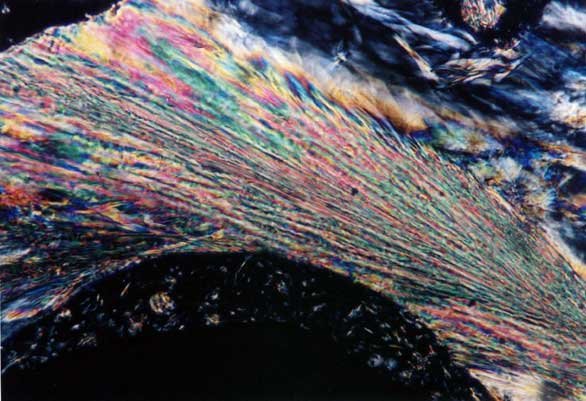
  • Glass-forming liquid crystal mixtures selectively reflect different colors

    Glass-forming liquid crystal mixtures selectively reflect different colors

    What the study found

    The study found that glass-forming ternary liquid crystalline mixtures can selectively reflect different colors of light depending on their phase and thermal history. In the glassy state, the mixtures reflect blue light, while in the smectic C* phase they reflect either green or red light.

    Why the authors say this matters

    The abstract does not explicitly state broader implications beyond the observation itself. The findings indicate that temperature treatment can influence which color is reflected by these mixtures.

    What the researchers tested

    The researchers examined ternary liquid crystalline mixtures that form glassy states and show a smectic C* phase, a liquid-crystal phase with tilted molecular order. They compared how the reflected color changed with cooling, heating, and different temperature-change rates.

    What worked and what didn't

    Both mixtures reflected blue light in the glassy state. In the smectic C* phase, the reflected color varied: the mixtures reflected either green or red light depending on whether the sample was cooled or heated, or on how quickly the temperature changed.

    What to keep in mind

    The abstract gives only a brief summary, so details about the mixtures, measurements, and experimental conditions are not provided here. Limitations are not described in the available summary.

    • The mixtures reflect blue light in the glassy state.
    • In the smectic C* phase, they reflect either green or red light.
    • The reflected color depends on temperature treatment, including cooling, heating, and rate of temperature change.
    • The abstract describes ternary liquid crystalline mixtures and does not provide further experimental detail.
  • Fourier bounds for Kakeya sets in finite fields

    What the study found

    The study found that a Kakeya set in a vector space over a finite field supports a probability measure whose Fourier transform is bounded for all non-zero frequencies. The authors also report that this bound is sharp in all dimensions at least 2.

    Why the authors say this matters

    The authors say this gives a Fourier analytic proof that a Kakeya set in dimension 2 must have size at least the stated lower bound, which they describe as asymptotically sharp. The study also suggests analogous results for sets containing planes in specified orientations.

    What the researchers tested

    The paper studies Kakeya sets in vector spaces over finite fields using Fourier analysis. It also considers sets containing planes in a given set of orientations.

    What worked and what didn't

    The authors prove the Fourier transform bound for non-zero frequencies and show that it cannot be improved in dimensions 2 and above. They also obtain an analogous result for sets containing planes in specified orientations.

    What to keep in mind

    The abstract does not provide the exact numerical bounds, so those details are not included here. It also does not describe limitations beyond the stated scope over finite fields and dimensions at least 2.

    • Kakeya sets over finite fields support a probability measure with a bounded Fourier transform at non-zero frequencies.
    • The bound is reported to be sharp in all dimensions at least 2.
    • The authors say this yields a Fourier analytic proof of a lower bound on the size of two-dimensional Kakeya sets.
    • The abstract also mentions analogous results for sets containing planes in specified orientations.
  • Extremal signed complete graphs with a K2,2-minor-free negative subgraph

    What the study found

    The authors characterize the extremal signed complete graphs that achieve the maximum and second maximum index, where the negative-edge-induced subgraph is K2,2-minor free. Here, a signed complete graph means a complete graph with edges labeled positive or negative, and the negative-edge-induced subgraph is the subgraph formed by the negative edges.

    Why the authors say this matters

    The abstract says that characterizing the extremum problem of the index of a signed complete graph is a concern in signed graphs. The study suggests this result helps address that extremal problem under the condition that the negative-edge-induced subgraph is K2,2-minor free.

    What the researchers tested

    The researchers studied a signed complete graph Γ = (K_n, H^-), where H^- is the negative-edge-induced subgraph. They examined the case in which H is a spanning subgraph of K_n that is K2,2-minor free, and they analyzed which signed complete graphs give the largest and second largest index.

    What worked and what didn't

    The abstract states that the extremal signed complete graphs achieving the maximum index were characterized. It also states that the extremal graphs achieving the second maximum index were characterized. No additional specific graph forms or comparisons are given in the abstract.

    What to keep in mind

    The available summary does not describe the exact characterization results or the mathematical form of the index. It also does not state limitations, examples, or applications beyond the K2,2-minor-free setting.

    • The paper studies signed complete graphs with negative edges forming a K2,2-minor-free subgraph.
    • It characterizes the graphs with the maximum index in this setting.
    • It also characterizes the graphs with the second maximum index.
    • The abstract frames this as part of an extremum problem in signed graphs.