Tag: Artificial Intelligence & Machine Learning

  • Embodied conversational agents improved response detail and engagement

    What the study found

    The study found that photorealistic embodied conversational agents, which are virtual agents that talk with users, can improve the quality of survey responses and increase engagement. Satisfaction did not show a significant change.

    Why the authors say this matters

    The authors say these findings support new AI-driven embodiment-based methods for turning online surveys into more natural interactions that resemble in-person interviews. The study suggests this could help address careless responding and satisficing in online surveys.

    What the researchers tested

    The researchers introduced a method called Virtual Agent Interviewer and validated it in a randomized, between-subjects study. The study used 80 participants from the U.K. general population, who either talked to a voice-based agent with an animated video avatar or interacted with a chatbot.

    What worked and what didn't

    Across 2,265 conversation responses from surveys based on two self-reported psychometric tests, statistical comparison showed significant gains in how informative and detailed responses were, along with higher and more time-efficient engagement. The study found no significant change in satisfaction. Qualitative analysis linked this to personal preferences, turn-taking delays, and Uncanny Valley reactions, which is a discomfort some people feel toward almost-human-looking avatars.

    What to keep in mind

    This is described as a proof-of-concept study, so the findings are limited to the tested setup and sample. The abstract does not describe additional limitations beyond the qualitative reasons offered for the lack of change in satisfaction.

    • Embodied conversational agents improved the informativeness and detail of survey responses.
    • Engagement was higher and more time-efficient with the embodied agent.
    • Satisfaction did not change significantly.
    • The study compared a voice-based animated avatar with a chatbot.
    • Qualitative findings pointed to personal preferences, turn-taking delays, and Uncanny Valley reactions.
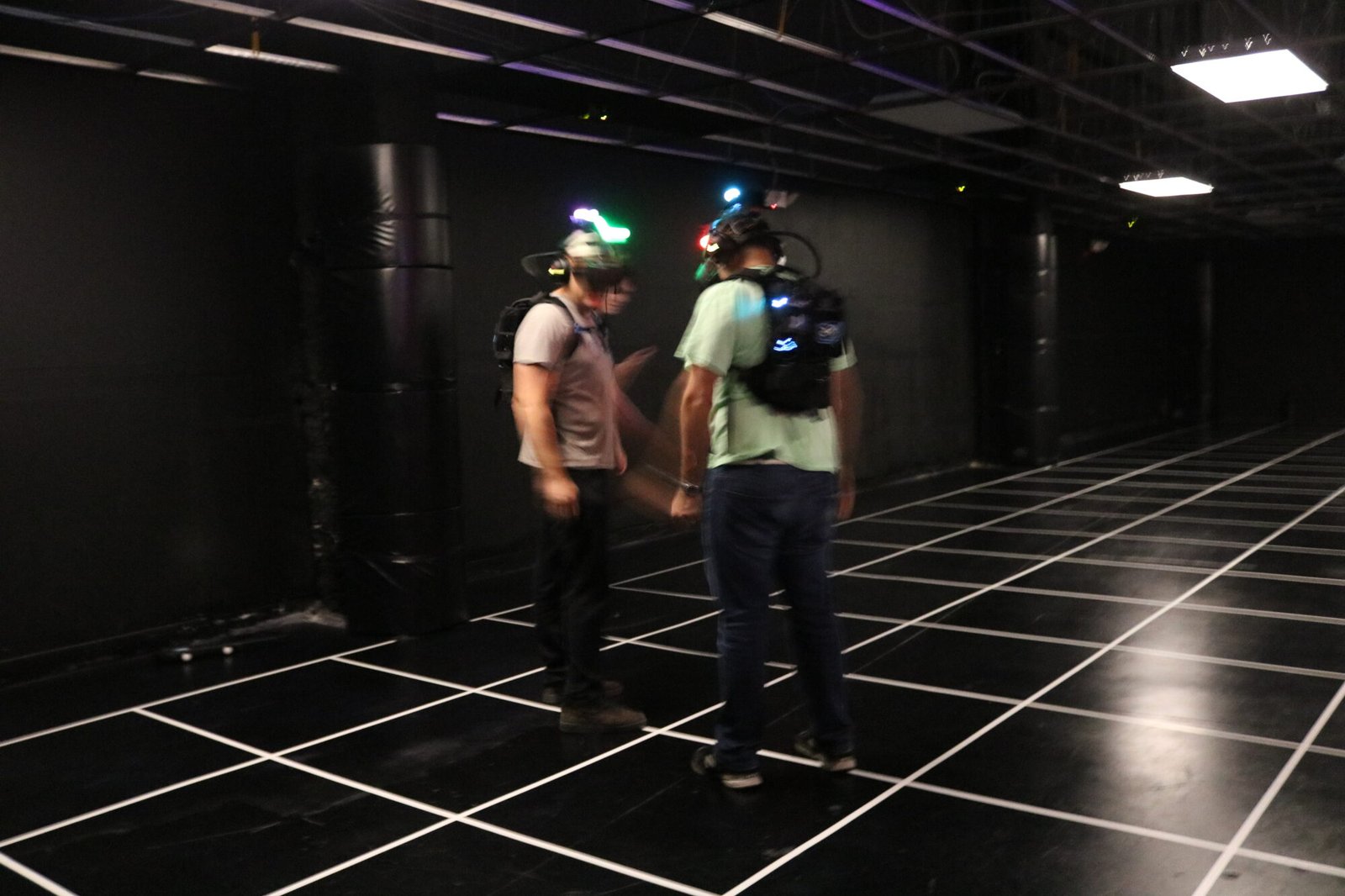
  • Collaborative VR authoring adds coordination overhead

    Collaborative VR authoring adds coordination overhead

    What the study found

    The study found that collaborative authoring of virtual reality environments is feasible, but it adds coordination overhead and does not improve overall efficiency. Participants preferred PC-based authoring over VR-based authoring and preferred working with another human over working with an AI assistant.

    Why the authors say this matters

    The authors conclude that collaborative VR end-user development tools are technically feasible, but they are not yet perceived as suitable alternatives to PC-based authoring, especially for VR-based authoring. The study suggests this has implications for designing collaborative VR authoring systems and for future research on combining human and AI collaborators in immersive authoring environments.

    What the researchers tested

    The researchers presented Co-VREUD, a web-based end-user development tool for co-creating VR environments. Co-VREUD supported real-time collaboration between two users or between a human user and an AI assistant, and it allowed authoring from both PC-based and VR-based interfaces.

    What worked and what didn't

    In a controlled 2 × 2 between-subject study with 32 participants, the researchers compared collaboration type (human-human vs. human-AI) and device type (PC vs. VR). The results showed additional coordination overhead in collaboration without overall efficiency gains, and participants consistently preferred PC over VR and human collaborators over AI assistants. Qualitative observations also showed distinct collaboration behavior patterns during human-human collaboration.

    What to keep in mind

    The summary does not describe detailed limitations beyond the study setting and sample size. The findings come from a controlled study with 32 participants, so the results are limited to the conditions tested.

    • Co-VREUD was designed for real-time collaborative authoring of VR environments.
    • The study compared human-human collaboration with human-AI collaboration.
    • Participants preferred PC-based authoring over VR-based authoring.
    • Participants favored collaborating with another human over collaborating with an AI assistant.
    • Collaboration added coordination overhead without improving overall efficiency.
  • Study maps human-centric evaluation of semantic resources

    What the study found

    The study found that human-centric evaluation of semantic resources, such as ontologies and knowledge graphs, has been studied in a way that can be organized into a theoretical framework. It also identified approaches, trends, and best practices from 15 years of published work.

    Why the authors say this matters

    The authors conclude that this work can help enable new research in this area and offer practical guidelines for performing human-centric evaluation of semantic resources to researchers and practitioners alike.

    What the researchers tested

    The researchers first integrated existing literature into a theoretical framework for defining and characterizing human-centric evaluation of semantic resources (evaluation that depends on human participation rather than automatic checking alone). They then conducted a systematic mapping study of 144 papers published over 15 years.

    What worked and what didn't

    The mapping study appears to have been useful for grounding and extending the theoretical framework. It also identified current trends and practices, although the abstract does not list specific methods that worked better or worse than others.

    What to keep in mind

    The abstract does not describe detailed limitations of the study. The summary also does not provide specific findings about particular semantic resources, domains, or evaluation methods beyond the general mapping of the literature.

    • The article focuses on human-centric evaluation of semantic resources such as ontologies and knowledge graphs.
    • The authors say this area lacked a systematic theoretical understanding and overview of approaches and trends.
    • The study mapped 15 years of research and covered 144 papers.
    • The work aimed to ground and extend a theoretical framework for the area.
    • The authors say the resulting foundations, trends, and practices may support future research and practical guidance.
  • CORE improves link prediction with compact graph augmentations

    What the study found

    The study reports that CORE, short for COmplete and REduce, is a new data augmentation method for link prediction in graph representation learning. The authors say it learns compact and predictive graph augmentations by recovering missing edges while removing noisy or spurious information.

    Why the authors say this matters

    The authors say this matters because link prediction models can be weakened by noise in graphs and by incomplete graph data. The study suggests CORE may improve robustness and performance for link prediction.

    What the researchers tested

    The researchers proposed CORE using the Information Bottleneck principle, which is a framework for keeping only the most useful information while discarding unnecessary detail. They evaluated the method on multiple benchmark datasets for link prediction.

    What worked and what didn't

    The abstract says extensive experiments showed CORE was applicable and superior to state-of-the-art methods on multiple benchmark datasets. It also states that CORE aims to recover missing edges and remove noise, but the abstract does not provide detailed numerical results or describe specific cases where it did not work.

    What to keep in mind

    The available summary does not give the experimental setup details, dataset names, or performance numbers. It also does not describe specific limitations beyond noting that graphs can contain noisy, spurious, and incomplete information.

    • CORE is a data augmentation method for link prediction in graph representation learning.
    • The method is designed to recover missing edges and remove noisy or spurious graph information.
    • The authors base CORE on the Information Bottleneck principle.
    • The abstract says experiments on multiple benchmark datasets showed CORE outperformed state-of-the-art methods.
    • The abstract does not report detailed results, dataset names, or specific limitations.
  • Balanced quasi-clique model for signed graphs

    What the study found

    The study proposes a maximal balanced (gamma1, gamma2)-quasi-clique (MBQC) model for signed graphs, where signed graphs are networks with positive and negative edges. The authors state that this model preserves quasi-completeness and aligns with structural balance theory.

    Why the authors say this matters

    The authors say this matters because existing quasi-clique definitions and algorithms were designed for unsigned graphs, while many real-world networks are signed graphs. The study suggests MBQC provides a quasi-clique model tailored to signed graphs.

    What the researchers tested

    The researchers formulated the problem of enumerating MBQCs in a signed graph and proved it is NP-hard, meaning it is computationally difficult in general. They then developed a branch-and-bound algorithm, a search method that systematically explores possibilities while pruning unlikely ones, with additional techniques to improve efficiency.

    What worked and what didn't

    The abstract reports that the proposed algorithms were optimized with several carefully crafted pruning techniques. It also says extensive experiments on real-world datasets demonstrated the efficiency, scalability, and effectiveness of the MBQC model and algorithms, but it does not give specific numerical comparisons in the abstract.

    What to keep in mind

    The abstract does not provide detailed experimental results, dataset descriptions, or exact performance measures. It also states that the enumeration problem is NP-hard, so the task is difficult in general even though the proposed method is reported to work well in experiments.

    • The paper proposes a maximal balanced (gamma1, gamma2)-quasi-clique model for signed graphs.
    • Signed graphs are described as networks with positive and negative edges.
    • The authors say the model preserves quasi-completeness and fits structural balance theory.
    • MBQC enumeration is proved to be NP-hard.
    • A branch-and-bound algorithm with pruning techniques was developed and tested on real-world datasets.
  • TRAVELER benchmark reveals weaker LLM temporal reasoning with vague references

    What the study found

    The study found that TRAVELER is a benchmark for testing temporal reasoning, meaning the ability to interpret time-related references such as explicit dates, implicit references like "yesterday," and vague references like "recently." When evaluated on this benchmark, the large language models tested did well on small event sets and explicit references, but their performance dropped as event sets grew and references became less explicit.

    Why the authors say this matters

    The authors conclude that TRAVELER helps expose limitations in current large language models' event-temporal reasoning capabilities. They also say the publicly available benchmark can be used to test other models beyond those evaluated in the study.

    What the researchers tested

    The researchers introduced TRAVELER, a synthetic question-answering benchmark built from past events in a household domain. It contains 3,300 English questions generated automatically with four templates from event sets containing 5 to 100 events, and it includes explicit, implicit, and vague temporal references.

    What worked and what didn't

    The benchmarked large language models could answer questions over event sets with only a handful of events and with explicit temporal references successfully. Performance clearly deteriorated with larger event sets and when temporal references were less explicit, and the vague question category showed the lowest performance across all models.

    What to keep in mind

    The benchmark uses synthetic questions from a household domain, so the reported results are tied to that setup. For vague references, ground-truth answers were established through human surveys on Prolific, and the abstract does not describe other limitations.

    • TRAVELER is a benchmark for temporal reasoning over explicit, implicit, and vague time references.
    • It includes 3,300 English questions generated from event sets with 5 to 100 events.
    • Four tested large language models performed well on small event sets and explicit references.
    • Performance dropped as event sets got larger and temporal references became less explicit.
    • Vague temporal questions had the lowest performance across all models.
  • Teacher candidates mostly view AI positively in language learning

    Teacher candidates mostly view AI positively in language learning

    What the study found

    Turkish language teacher candidates generally described AI (artificial intelligence) in language learning with mostly positive or neutral metaphors. Most participants saw AI as a teacher, learner, method, strategy, guide, helper, or an evolving living organism, while a smaller group viewed it as a danger or threat.

    Why the authors say this matters

    The authors conclude that these views highlight the importance of adding AI literacy and ethics to teacher education. They suggest that preparing future language teachers to use AI in a confident, critical, and human-centred way may support AI use in schools.

    What the researchers tested

    The study used a qualitative phenomenological design to explore metaphors used by 46 Turkish language teacher candidates in Northern Cyprus. Participants were third- and fourth-year undergraduates who answered the prompt, “AI is like because…”, and their responses were analyzed with content analysis and expert validation.

    What worked and what didn't

    The researchers identified 46 valid metaphors and grouped them into five thematic categories: AI as Teacher or Learner, Method/Strategy, Evolving Living Organism, Guide/Helper, and Danger/Threat. Four of these categories reflected positive or neutral attitudes, and one reflected negative views; overall, 78.3% of participants expressed optimistic views and 21.7% expressed concerns.

    What to keep in mind

    The abstract describes a single group of 46 Turkish language teacher candidates in Northern Cyprus, so the findings are limited to that sample. It does not report broader testing beyond the metaphor analysis, and no additional limitations are described in the available summary.

    • 46 Turkish language teacher candidates took part in the study.
    • Participants produced 46 valid metaphors about AI in language learning.
    • Five themes emerged, including AI as teacher/learner, guide/helper, and danger/threat.
    • Most participants, 78.3%, expressed optimistic views about AI.
    • The authors say AI literacy and ethics should be included in teacher education.
  • Chat option increased collaboration in social virtual reality

    Chat option increased collaboration in social virtual reality

    What the study found

    The study found that collaboration rates were higher when a chat option was available, especially in social virtual reality (SVR), which is a virtual environment for social interaction, than without chat. The authors also report that this pattern fits with anthropomorphism theory, which is about people attributing human-like qualities to nonhuman systems.

    Why the authors say this matters

    The authors conclude that the design of new virtual worlds should include a mix of real-life and virtual features. They also state that using a chat option in SVR systems for ride-sharing and other similar social situations should be encouraged.

    What the researchers tested

    The researchers ran a 2-by-2 between-participants experiment with 120 participants. Four groups of 30 used a ride-sharing simulation based on the repeated prisoner’s dilemma paradigm, comparing system type (SVR or video-mediated communication, meaning communication through video) and whether chat was available or not.

    What worked and what didn't

    Collaboration rates were higher with chat than without it. The effect was strongest in the SVR condition.

    What to keep in mind

    The abstract does not provide detailed limitations beyond saying that the theoretical idea of mixing real-life and virtual features requires additional investigation. No other caveats are described in the available summary.

    • The study compared social virtual reality with video-mediated communication.
    • A chat option increased collaboration rates overall.
    • The chat effect was especially strong in social virtual reality.
    • The experiment used 120 participants in four groups.
    • The authors say the design of virtual worlds should mix real-life and virtual features.
  • Heterogeneous graph model improves representation learning

    What the study found

    The study reports that HMMC, a self-supervised heterogeneous graph neural network, outperformed state-of-the-art baselines on multiple public heterogeneous graph datasets. The abstract says the method achieved gains of 0.5% to 4.1% across benchmarks.

    Why the authors say this matters

    The authors conclude that HMMC improves representation power, robustness, and generalization capability for heterogeneous graph learning tasks. They also say the method helps balance local structural detail and global semantic consistency.

    What the researchers tested

    The researchers introduced HMMC, which combines multi-scale meta-path embedding with cross-view self-supervised contrastive learning. A meta-path is a sequence of node types used to capture relationships in a heterogeneous graph, and the model also uses a star-shaped contrastive loss.

    What worked and what didn't

    The abstract says multi-scale meta-path embedding was designed to capture both local and global structural information, avoiding the limits of overly short meta-paths and the noise from overly long ones. It also says the cross-view contrastive framework and star-shaped loss were proposed to address noisy negative samples and over-smoothing; the reported experiments showed improved performance over baselines.

    What to keep in mind

    The summary does not provide dataset names, task details, or implementation settings. It also does not describe specific failure cases, statistical tests, or limitations beyond the problem statements motivating the method.

    • HMMC is a self-supervised heterogeneous graph neural network.
    • It uses multi-scale meta-path embedding to capture local and global structure.
    • It adds cross-view contrastive learning and a star-shaped contrastive loss.
    • The method outperformed state-of-the-art baselines on multiple public datasets.
    • The abstract reports gains of 0.5% to 4.1% across benchmarks.
  • AI is reshaping marketing jobs and practices in Poland

    What the study found

    The study found that AI is changing marketing work in Poland, with fewer traditional marketing job offers and growing interest in AI tools. It also points to changes in marketing practices, especially in content creation and customer engagement.

    Why the authors say this matters

    The authors conclude that AI offers opportunities for greater efficiency and innovation, but also creates challenges for job displacement and new skill requirements in the marketing workforce. The study suggests these changes matter for both job roles and market dynamics.

    What the researchers tested

    The researchers used a mixed-methods approach. They analyzed job postings data from online platforms in Poland, used Google Trends to measure interest in AI tools in the U.S. and Poland, and examined case studies of AI applications in marketing.

    What worked and what didn't

    The findings indicate a significant decline in traditional marketing job offers in Poland. At the same time, interest in AI-driven tools was growing, particularly for content creation and customer engagement. The abstract also notes possible benefits in efficiency and innovation, alongside challenges tied to job displacement and the need for new skills.

    What to keep in mind

    The abstract focuses on the Polish market, so the findings are specific to that context. It does not provide detailed limitations beyond the mixed-methods design and the data sources described.

    • Traditional marketing job offers in Poland declined significantly.
    • Interest in AI tools increased in both Poland and the U.S. according to Google Trends.
    • AI interest was especially strong for content creation and customer engagement.
    • The authors say AI may improve efficiency and innovation.
    • The study also notes challenges linked to job displacement and new skill needs.