Tag: Plasma Physics & Fusion

  • Laser-plasma VHEE modeling showed favorable deep dose delivery

    What the study found

    The study found that polychromatic very high-energy electron beams generated by a laser-plasma accelerator, and delivered through the modeled beamline, can achieve favorable dose distribution for reaching deep areas inside a phantom. The authors also describe the workflow as useful for exploring and optimizing this radiotherapy approach.

    Why the authors say this matters

    The authors say this matters because very high-energy electron radiotherapy has attracted interest for its dose distribution capabilities and potential to address limitations of traditional photon-based radiotherapy. They conclude that the workflow could support further research and possible clinical implementation.

    What the researchers tested

    The researchers developed a start-to-end simulation workflow for very high-energy electron radiotherapy, from source generation to dose delivery. They used particle-in-cell simulations of laser-plasma interaction to generate realistic electron beams, then modeled a beamline with quadrupoles, a collimator, and dipoles, and finally used GEANT4 to calculate dose deposition in water phantoms and heterogeneous phantoms with bone inserts.

    What worked and what didn't

    The simulations showed that the modeled polychromatic beams could be collimated, filtered, and arranged into a beam array, and that multi-angle irradiation could be studied at the isocenter. The abstract does not report specific failures or negative outcomes.

    What to keep in mind

    This is a simulation study, so the findings are based on modeling rather than clinical treatment. The abstract does not provide quantitative performance values, and it does not describe experimental validation or limitations beyond the simulated phantom setups.

    • The study modeled very high-energy electron radiotherapy from the source through dose delivery.
    • Laser-plasma interaction simulations were used to generate realistic electron beams.
    • A beamline with quadrupoles, a collimator, and dipoles was used to shape and arrange the beams.
    • Dose deposition was calculated in water phantoms and phantoms with bone inserts using GEANT4.
    • The modeled beams showed favorable dose distribution for reaching deep areas inside the phantom.
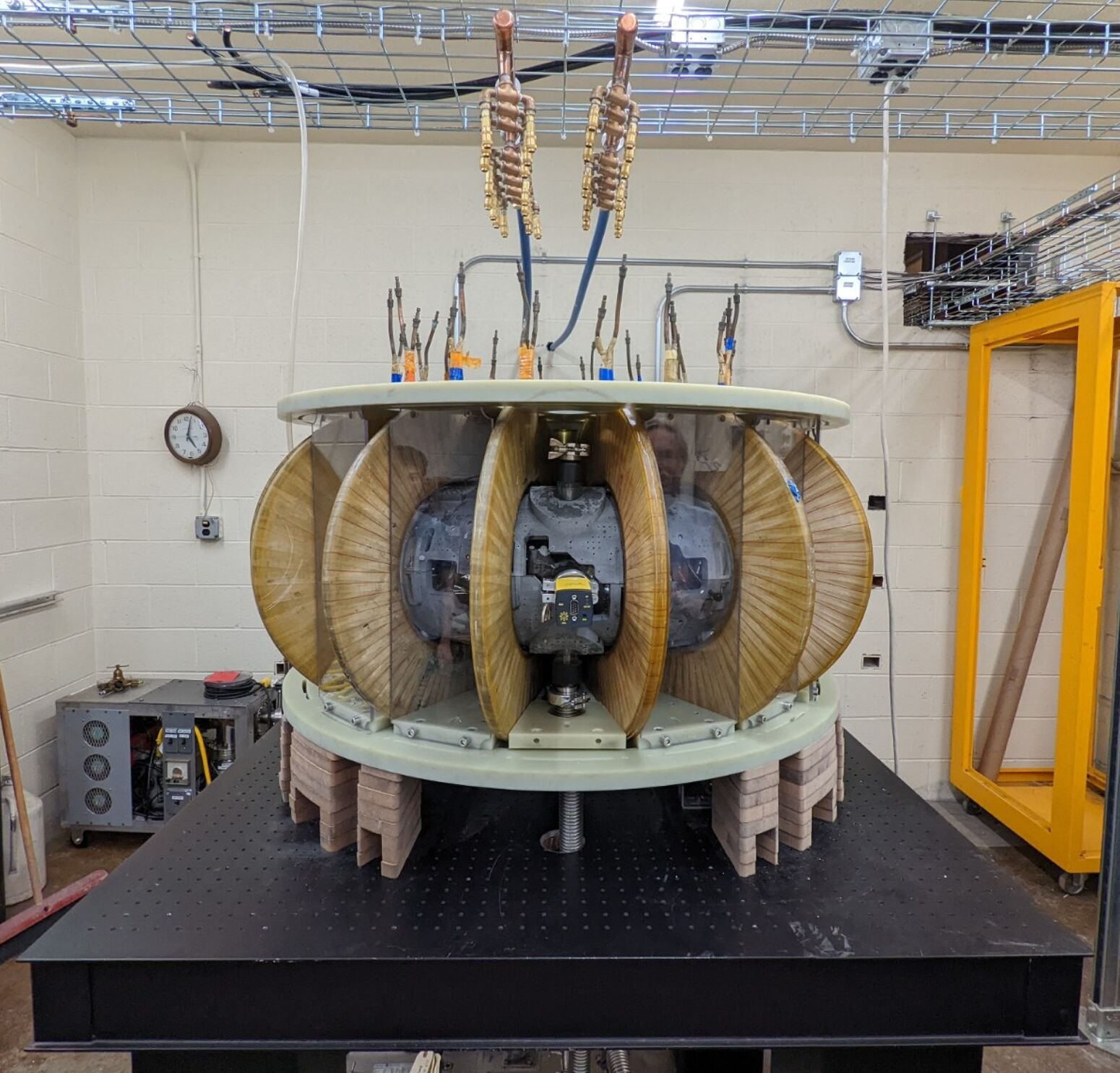
  • Controlled acceleration reveals Rayleigh–Taylor instability behavior

    What the study found

    The study found that the CAMPI apparatus could generate prescribed, complex acceleration histories for experiments on Rayleigh–Taylor instability, a fluid instability that occurs when one fluid is accelerated into another. The experiments showed growth reaching terminal velocity, then shrinking and homogenisation of the mixing region during deceleration, and unstable growth during a second acceleration phase.

    Why the authors say this matters

    The authors say the apparatus is a much needed resource for ground truth data on Rayleigh–Taylor instability across a broad range of regimes. The study suggests this is important because acceleration history and initial interface frequency content strongly affect turbulent mixing, and these are difficult to control and diagnose in experiments.

    What the researchers tested

    The researchers presented the CAMPI, or Controlled Acceleration for Multi-Phase Instabilities, apparatus for low Atwood number Rayleigh–Taylor instability experiments with fully miscible fluids. They tested an initially single-mode instability through two stepwise acceleration reversals, a case they called Accel-Decel-Accel, and used high-resolution optical diagnostics at a suitable experimental scale.

    What worked and what didn't

    The apparatus successfully produced the intended acceleration history. The observed instability behaviour matched previous numerical studies: the mixing region grew to terminal velocity during the first acceleration, shrank and homogenised during deceleration, and then grew again from a multi-frequency initial condition during the second acceleration.

    What to keep in mind

    The abstract does not describe detailed limitations, error measurements, or performance bounds. The reported results are for low Atwood number Rayleigh–Taylor instability with fully miscible fluids in the specific Accel-Decel-Accel test case.

    • CAMPI is an experimental facility for studying Rayleigh–Taylor instability with controllable acceleration histories.
    • The apparatus was designed for low Atwood number experiments using fully miscible fluids.
    • A two-step acceleration reversal test showed that CAMPI could accurately generate the prescribed acceleration history.
    • The observed instability evolution agreed with previous numerical studies.
    • The abstract presents CAMPI as a source of ground truth data across a broad range of Rayleigh–Taylor regimes.
  • Free-bound transitions affect warm dense matter temperature measurements

    What the study found

    The study found that free-bound transitions, in which free electrons are de-excited into thermally unoccupied bound states while transferring momentum and energy to a scattered x-ray photon, are a feature of warm dense matter. The authors report that these transitions vanish in the limits of cold and hot temperatures.

    Why the authors say this matters

    The authors say this matters because warm dense matter experiments are often interpreted through models with systematic errors that are difficult to quantify. The study suggests that including free-bound transitions is required to obtain a physically consistent temperature from the Chihara decomposition, which the authors present as an important step for precisely characterizing warm dense matter.

    What the researchers tested

    The researchers analyzed recent X-ray Thomson Scattering experiments on warm dense matter at the National Ignition Facility and the Linac Coherent Light Source. They tested whether adding free-bound transitions to the analysis changes the temperature inferred from the Chihara decomposition, and they compared that interpretation with a recently developed model-free thermometry technique.

    What worked and what didn't

    Including free-bound transitions in the analysis was required to obtain a physically consistent temperature from the Chihara decomposition. The interpretation was corroborated by agreement with the model-free thermometry technique. The abstract does not describe any specific analysis that worked without these transitions beyond noting that their inclusion was necessary.

    What to keep in mind

    The abstract does not provide quantitative details about the size of the effect or the experimental conditions beyond the named facilities and technique. It also does not describe limitations of the study in the available summary.

    • Free-bound transitions are described as a feature of warm dense matter.
    • These transitions vanish in the limits of cold and hot temperatures.
    • Including them was required to get a physically consistent temperature from the Chihara decomposition.
    • The interpretation matched a model-free thermometry technique.
    • The work was applied to X-ray Thomson Scattering experiments at the National Ignition Facility and the Linac Coherent Light Source.
  • Helios design uses optimized planar coil stellarator equilibrium

    Helios design uses optimized planar coil stellarator equilibrium

    What the study found

    The paper reports an optimized preconceptual design for Helios, a fusion power plant based on a planar coil stellarator architecture. The resulting design is described as a two-field-period, low aspect ratio, quasi-axisymmetric stellarator with a tokamak-like X-point divertor.

    Why the authors say this matters

    The authors conclude that the design satisfies the high-level requirements they set for a fusion power plant, including confinement of fusion-born alpha particles, nonlinear stability at high pressure, and a feasible divertor. They also say the optimization process promises further improvements with continued work.

    What the researchers tested

    The researchers developed single-stage optimization tools to compute free-boundary equilibria, meaning plasma balance configurations shaped by planar coil sets. They also implemented optimization functions aimed at equilibria that confine alpha particles, remain nonlinearly stable at high pressure, and include a feasible divertor.

    What worked and what didn't

    The effort yielded an attractive preconceptual design for Helios, according to the abstract. The paper says the equilibrium properties satisfy all of the stated high-level requirements, but it does not provide detailed quantitative comparisons or note specific failures in the abstract.

    What to keep in mind

    This summary is based only on the abstract, so technical details are limited. The work describes a preconceptual design and optimization process; the abstract does not describe experimental validation, cost, or engineering constraints beyond the stated equilibrium requirements.

    • Helios is presented as a fusion power plant design based on planar coil stellarator architecture.
    • The optimized design is two-field-period, low aspect ratio, and quasi-axisymmetric.
    • The design includes a tokamak-like X-point divertor.
    • The optimization targeted alpha-particle confinement, nonlinear stability at high pressure, and a feasible divertor.
    • The abstract says the resulting equilibrium properties satisfy the stated high-level requirements.
  • Helios stellarator analysis finds a near-ignited plasma scenario

    What the study found

    The study found that a near-ignited scenario for the Helios stellarator fusion power plant can be identified. In that scenario, the model predicts 945 MW of fusion power and a fusion gain of 47.

    Why the authors say this matters

    The authors present the analysis as part of understanding the transport properties and profile prediction for the preconceptual Helios design. The findings suggest the modeled plasma conditions are close to ignition, with performance values compared against reference targets.

    What the researchers tested

    The researchers used a multi-scale framework that includes turbulent timescales in macroscopic profile evolution on transport timescales. They ran high-fidelity electrostatic gyrokinetic and drift-kinetic calculations to simulate transport fluxes, using a prescribed density profile and including alpha heating power, auxiliary electron heating, radiation losses, and collisional energy exchange.

    What worked and what didn't

    The analysis found a steady-state temperature profile for a near-ignited scenario. It reported P fus = 945 MW, Q fus = 47, H ISS04 = 1.34, and a Sudo density fraction of 1.25, which the authors compare with reference values of 958 MW, 1.4, and 1.1, respectively. Additional calculations with fully kinetic impurities showed a strong reduction in gyrokinetic heat and particle fluxes for the bulk ions.

    What to keep in mind

    The abstract describes a preconceptual design study, so the results are model-based rather than experimental. It also notes that the density profile was prescribed, and the provided summary does not describe further limitations.

    • A near-ignited Helios scenario was found in the modeling study.
    • The modeled case predicts 945 MW of fusion power and a fusion gain of 47.
    • The reported confinement scaling factor was H ISS04 = 1.34.
    • The Sudo density fraction was 1.25, above the reference value cited in the abstract.
    • Fully kinetic impurities strongly reduced gyrokinetic heat and particle fluxes for bulk ions.
  • Dual-laser fields alter relativistic hydrogen atom scattering

    What the study found

    The study found that relativistic differential cross sections for elastic electron scattering from a hydrogen-like atom depend strongly on whether the interaction is field-free, under one laser field, or under two laser fields. The authors report that polarization has a determining influence on the scattering dynamics.

    Why the authors say this matters

    The authors say the results provide predictive insight for future dual-laser experiments. They also conclude that the findings confirm the validity of the Kroll–Watson sum rule, a relation used to describe photon exchange in laser-assisted scattering, for both laser fields.

    What the researchers tested

    The researchers studied elastic scattering of hydrogen-like atoms by electron impact in the presence of two orthogonally polarized monochromatic laser fields. They used the first Born approximation, described the incident and scattered electrons with Volkov solutions, and modeled hydrogen in its metastable 2s 1/2 state with an exact relativistic wave function.

    What worked and what didn't

    They derived relativistic differential cross sections for three cases: field-free, single-laser, and dual-laser configurations. A systematic analysis showed how the cross sections vary with incident electron energy and laser parameters, and the authors report that polarization affects the scattering dynamics. The abstract does not report any configuration as failing or being ineffective.

    What to keep in mind

    The summary is limited to elastic scattering from hydrogen-like atoms in the metastable 2s 1/2 state and to the specific theoretical setup described. The abstract does not mention experimental measurements, numerical values, or detailed limitations beyond the modeled configurations.

    • The study compares field-free, single-laser, and dual-laser scattering of a hydrogen-like atom.
    • Polarization is reported to have a determining influence on the scattering dynamics.
    • The authors state that the Kroll–Watson sum rule remains valid for photon exchange with both laser fields.
    • Relativistic differential cross sections were derived using the first Born approximation and Volkov solutions.
    • The authors say the results may help guide future dual-laser experiments.
  • Weakly magnetized shocks accelerate ions and electrons differently

    What the study found

    The study found that in quasi-parallel transrelativistic shocks, the shock precursor is shaped by a competition between the Bell instability and the Weibel (filamentation) instability. Which instability dominates depends on magnetization, and that difference changes how efficiently ions and electrons gain nonthermal energy.

    Why the authors say this matters

    The authors conclude that these results are applicable to a wide range of transrelativistic shocks, including the termination shocks of extragalactic jets, the late stages of gamma-ray burst afterglows, and shocks in fast blue optical transients. The study suggests the instability regime can help determine how shock energy is divided between ions and electrons.

    What the researchers tested

    The researchers used long-duration two-dimensional particle-in-cell simulations, a numerical method that follows the motion of charged particles and electromagnetic fields self-consistently. They studied quasi-parallel transrelativistic shocks propagating in weakly magnetized plasmas across different magnetizations.

    What worked and what didn't

    Bell-dominated shocks, which occur at relatively high magnetizations (σ ≳ 10−3), efficiently accelerated ions and converted about ε_i ~ 0.2 of the upstream flow energy into downstream nonthermal ion energy. In this regime, only a much smaller fraction, ε_e ≪ 0.1, went into downstream nonthermal electrons. When the precursor was dominated by Weibel modes at lower magnetizations (σ ≲ 10−4), both ions and electrons were accelerated more evenly, with ε_i ~ ε_e ~ 0.1, but the maximum energy grew more slowly, with E_max ∝ t^1/2 rather than Bohm-like scaling E_max ∝ t.

    What to keep in mind

    The abstract does not describe limitations beyond the simulation setup and the magnetization range studied. The results are reported for long-duration two-dimensional simulations, so the summary available here does not say how the findings change in three-dimensional settings or outside the studied parameter range.

    • The shock precursor is controlled by a competition between Bell and Weibel instabilities.
    • Bell modes dominate at higher magnetization, while Weibel modes dominate at lower magnetization.
    • Bell-dominated shocks efficiently accelerate ions but much less efficiently accelerate electrons.
    • Weibel-dominated shocks produce comparable nonthermal ion and electron ენერგies, each around 0.1 of the upstream flow energy.
    • The maximum ion energy grows as E_max ∝ t in the Bell regime and as E_max ∝ t^1/2 in the Weibel regime.
  • Predictive gyrokinetic simulations matched TCV edge plasma data

    What the study found

    The study found that full-f global long-wavelength gyrokinetic simulations can reproduce key features of edge and scrape-off layer plasma behavior in tokamaks using only magnetic geometry, heating power, and particle inventory as inputs. The simulations also reproduced blob transport and self-organized electric fields.

    Why the authors say this matters

    The authors say this matters because fusion power-plant design needs computational tools that can estimate plasma behavior from engineering parameters without relying directly on measured plasma profiles. They conclude that the predictive capability they demonstrate suggests Gkeyll could support design studies of fusion devices.

    What the researchers tested

    The researchers ran full-f global long-wavelength gyrokinetic simulations of edge and scrape-off layer turbulence in tokamaks. They used an adaptive sourcing algorithm in Gkeyll to control energy injection and mimic particle sourcing from neutral recycling, and they compared results with Thomson scattering and Langmuir probe data from Tokamak á Configuration Variable discharge #65125. They also applied the same framework to study triangularity, a change in the plasma-shape geometry, using discharges #65125 and #65130.

    What worked and what didn't

    The simulated kinetic profiles compared reasonably well with the experimental data for discharge #65125. The simulations reproduced blob transport and self-organized electric fields, and the triangularity study suggested that negative triangularity increased E × B flow shear by about 20% in these cases, which correlated with reduced turbulent losses and a modest change in how power exhaust reached the vessel wall. The abstract also notes that the physical models contain approximations that can be refined in future work.

    What to keep in mind

    The study describes approximations in the physical models, and the abstract does not give a full accounting of their limits. The reported triangularity result comes from the specific TCV discharges studied, so the abstract does not claim it applies universally.

    • Full-f gyrokinetic simulations used only magnetic geometry, heating power, and particle inventory as inputs.
    • The simulated kinetic profiles matched Thomson scattering and Langmuir probe data reasonably well for TCV discharge #65125.
    • The simulations reproduced blob transport and self-organized electric fields.
    • Negative triangularity was associated with about 20% higher E × B flow shear in the cases studied.
    • The abstract says the models contain approximations that could be refined in future work.
  • Time-resolved measurements track heating and ionization in dense plasmas

    What the study found

    The study reports that sub-picosecond time-resolved resonant X-ray emission spectroscopy and absorption imaging can diagnose heating and ionization dynamics in solid-density plasmas created by high-intensity laser interactions. The authors also report that the measurements, together with simulations, help constrain plasma parameters such as temperature and ionization depth.

    Why the authors say this matters

    The authors conclude that the results provide new insights into heating and ionization dynamics in the high-energy-density regime relevant to inertial fusion energy research. They also describe the work as a benchmark for improving models of high-power laser-plasma interactions.

    What the researchers tested

    The researchers studied wire targets hit by high-intensity lasers and used an X-ray free-electron laser for sub-picosecond time-resolved resonant X-ray emission spectroscopy and absorption imaging. They compared the experiments with atomic collisional-radiative models, particle-in-cell simulations, and magnetohydrodynamics codes.

    What worked and what didn't

    The approach worked well enough to reveal strong sensitivity of basic plasma parameters in widely used models, including temperature and ionization depth. The simulations could be constrained when the models included laser spatial profiles, pre-plasma conditions, and collisional processes.

    What to keep in mind

    The abstract does not give detailed numerical results, and it does not describe specific limitations beyond the general difficulty of capturing spatiotemporal evolution experimentally. Any broader conclusions are limited to the high-energy-density laser-solid interaction conditions studied here.

    • The study used time-resolved resonant X-ray emission spectroscopy and absorption imaging to examine solid-density plasmas.
    • The measurements were made on wire targets driven by high-intensity lasers.
    • Comparisons with multi-scale simulations helped constrain temperature and ionization depth.
    • The authors say detailed modeling of laser spatial profiles, pre-plasma conditions, and collisional processes improved agreement.
    • The work is presented as relevant to inertial fusion energy research and laser-plasma model improvement.