What the study found
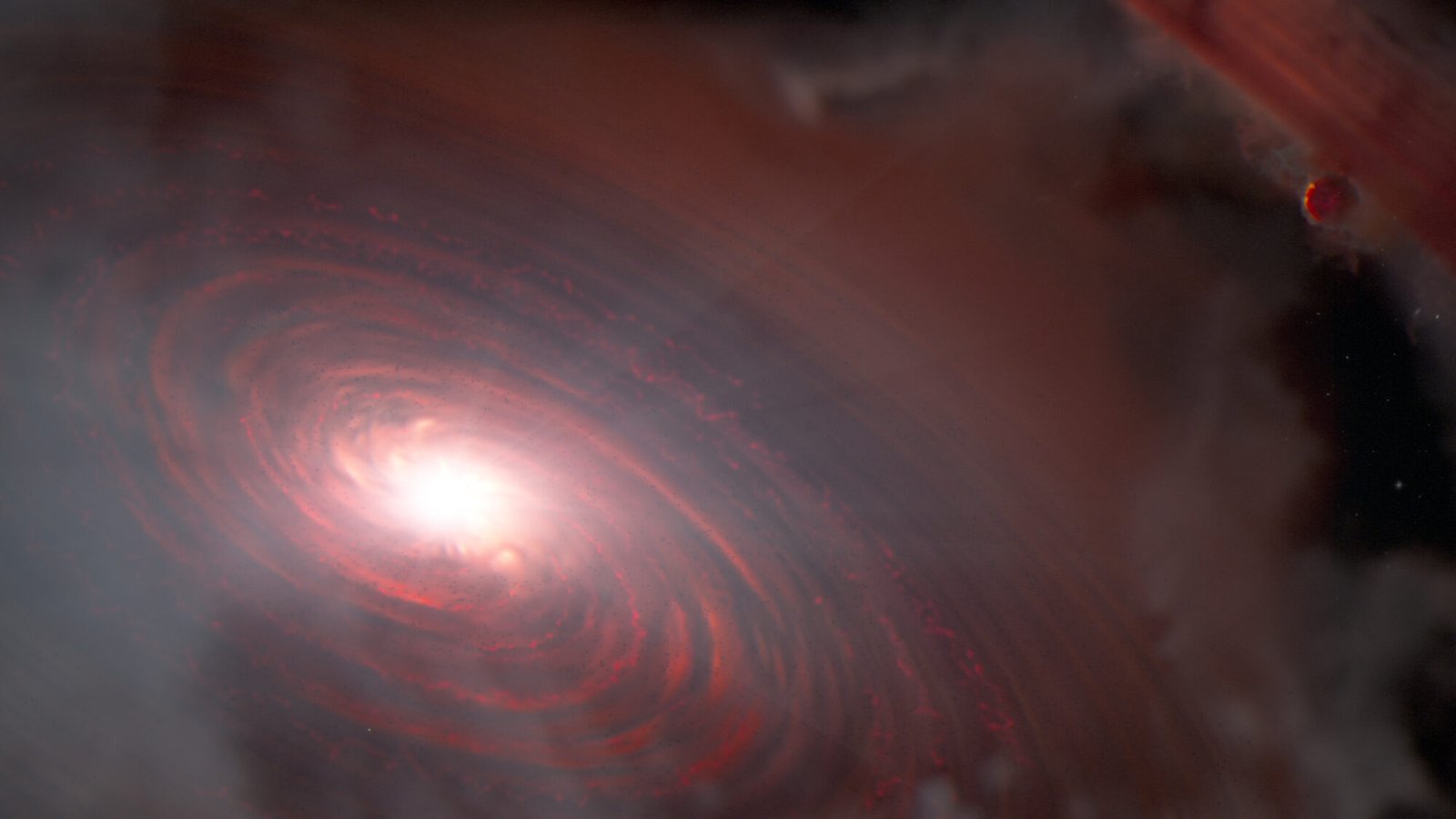
The study found that tomographic analysis of molecular lines can reveal signatures associated with embedded planets in protoplanetary disks, including changes in gas motion and line shape. In the examples discussed, the authors report possible embedded planets in HD 135344B and structures in MWC 758 that fit other disk processes.
Why the authors say this matters
The authors suggest this matters because it extends analysis beyond line-centroid kinematics, meaning it uses more than just the position of spectral lines to study disk motion. They conclude that this approach can help separate planet-driven signatures from those caused by disk instabilities.
What the researchers tested
The researchers used synthetic observations of planet-disk interactions and disk instabilities to test a tomographic study of molecular lines. They then applied the method to ALMA (Atacama Large Millimeter/submillimeter Array) CO line data from the disks of HD 135344B and MWC 758.
What worked and what didn't
The results indicate that a few hours of ALMA integration at moderate angular resolution could identify key signatures from planets more massive than 0.1% of the stellar mass. These signatures included deviations from Keplerian motion, localized line broadening, and line skewness that can help distinguish planetary from instability-driven signals; in HD 135344B, the analysis suggested three massive planets at about 95 au, 41 au, and 73 au, while in MWC 758 the observed pattern was more consistent with vertical-velocity spirals linked to moderate disk eccentricities or warps.
What to keep in mind
The abstract does not describe uncertainties, sample size limits, or external validation beyond the two disk examples. The reported planet locations in HD 135344B are presented as a possibility, and the MWC 758 interpretation is described as consistency with models rather than a direct detection.
Key points
- Tomographic molecular-line analysis was used to study embedded planet signatures in protoplanetary disks.
- The method is reported to detect deviations from Keplerian motion, localized line broadening, and line skewness.
- The authors say a few hours of ALMA observing time at moderate angular resolution may be enough to identify planets above 0.1% of stellar mass.
- HD 135344B showed localized velocity and line-width perturbations that suggest three possible massive planets.
- MWC 758 showed features more consistent with vertical-velocity spirals and possible moderate disk eccentricity or warps.
Disclosure
- Research title:
- Tomographic analysis identifies possible embedded planets in disk data
- Authors:
- Andrés F. Izquierdo, J. Bae, Stefano Facchini, Ewine F. van Dishoeck, Marcelo Barraza-Alfaro, Myriam Benisty, Richard Teague, Jochen Stadler, Sean M. Andrews, Gianni Cataldi, Nicolás Cuello, Pietro Curone, Ian Czekala, Daniele Fasano, Mario Flock, Misato Fukagawa, Maria Galloway-Sprietsma, Cassandra Hall, Jane Huang, John D. Ilee, Andrea Isella, Jensen Lawrence, Geoffroy Lesur, Giuseppe Lodato, Cristiano Longarini, Ryan A. Loomis, François Ménard, C. Pinte, Daniel J. Price, Giovanni Rosotti, Leonardo Testi, David J. Wilner, Andrew J. Winter, Lisa Wölfer, Brianna Zawadzki
- Institutions:
- Center for Astrophysics Harvard & Smithsonian, Center for Astrophysics Harvard & Smithsonian, Centre National de la Recherche Scientifique, Centre National de la Recherche Scientifique, Centre National de la Recherche Scientifique, Centre National de la Recherche Scientifique, Centre National de la Recherche Scientifique, Centre National de la Recherche Scientifique, Columbia University, European Southern Observatory, Institut de Planétologie et d'Astrophysique de Grenoble, Institut de Planétologie et d'Astrophysique de Grenoble, Institut de Planétologie et d'Astrophysique de Grenoble, Institut de Planétologie et d'Astrophysique de Grenoble, Istituto Nazionale di Fisica Nucleare, Sezione di Bologna, Leiden University, Leiden University, Massachusetts Institute of Technology, Massachusetts Institute of Technology, Massachusetts Institute of Technology, Massachusetts Institute of Technology, Max Planck Institute for Astronomy, Max Planck Institute for Astronomy, Max Planck Institute for Extraterrestrial Physics, Monash University, Monash University, National Astronomical Observatory of Japan, National Astronomical Observatory of Japan, National Radio Astronomy Observatory, Observatoire de la Côte d’Azur, Observatoire de la Côte d’Azur, Osservatorio astronomico di Bologna, Queen Mary University of London, Rice University, Université Côte d'Azur, Université Côte d'Azur, Université Grenoble Alpes, Université Grenoble Alpes, Université Grenoble Alpes, Université Grenoble Alpes, University of Bologna, University of Cambridge, University of Chile, University of Florida, University of Florida, University of Florida, University of Georgia, University of Leeds, University of Milan, University of Milan, University of Milan, University of St Andrews, Wesleyan University
- Publication date:
- 2026-03-16
- OpenAlex record:
- View
- Image credit:
- NASA, ESA, CSA, J. Olmsted (STScI), Wikimedia Commons, CC BY 4.0
Get the weekly research newsletter
Stay current with scholarly research without reading academic papers — one filtered digest, every Friday.