What the study found
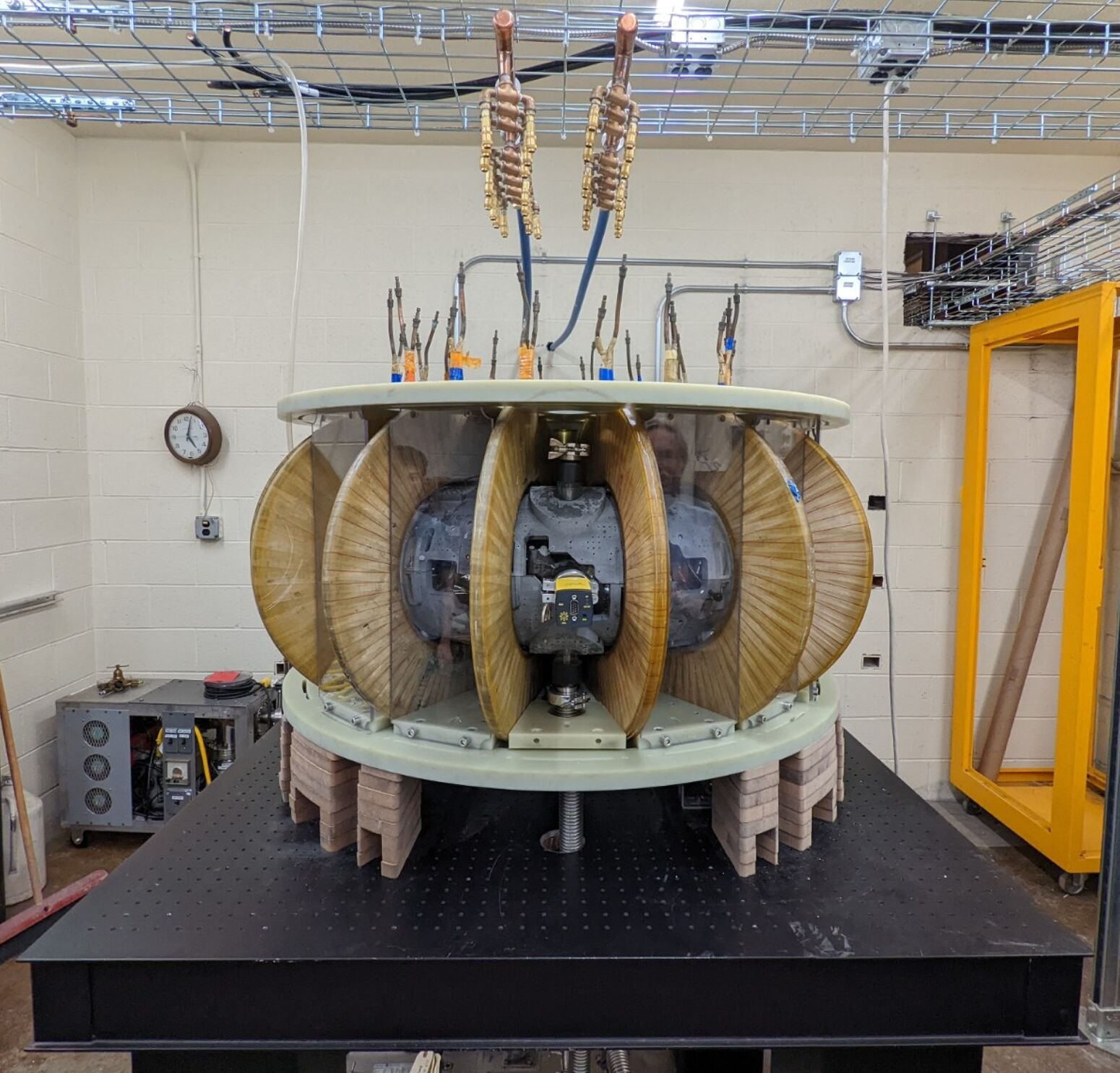
The paper reports an optimized preconceptual design for Helios, a fusion power plant based on a planar coil stellarator architecture. The resulting design is described as a two-field-period, low aspect ratio, quasi-axisymmetric stellarator with a tokamak-like X-point divertor.
Why the authors say this matters
The authors conclude that the design satisfies the high-level requirements they set for a fusion power plant, including confinement of fusion-born alpha particles, nonlinear stability at high pressure, and a feasible divertor. They also say the optimization process promises further improvements with continued work.
What the researchers tested
The researchers developed single-stage optimization tools to compute free-boundary equilibria, meaning plasma balance configurations shaped by planar coil sets. They also implemented optimization functions aimed at equilibria that confine alpha particles, remain nonlinearly stable at high pressure, and include a feasible divertor.
What worked and what didn't
The effort yielded an attractive preconceptual design for Helios, according to the abstract. The paper says the equilibrium properties satisfy all of the stated high-level requirements, but it does not provide detailed quantitative comparisons or note specific failures in the abstract.
What to keep in mind
This summary is based only on the abstract, so technical details are limited. The work describes a preconceptual design and optimization process; the abstract does not describe experimental validation, cost, or engineering constraints beyond the stated equilibrium requirements.
Key points
- Helios is presented as a fusion power plant design based on planar coil stellarator architecture.
- The optimized design is two-field-period, low aspect ratio, and quasi-axisymmetric.
- The design includes a tokamak-like X-point divertor.
- The optimization targeted alpha-particle confinement, nonlinear stability at high pressure, and a feasible divertor.
- The abstract says the resulting equilibrium properties satisfy the stated high-level requirements.
Disclosure
- Research title:
- Helios design uses optimized planar coil stellarator equilibrium
- Authors:
- Daniel Dudt, M. Avida, E. Flom, Thomas Krüger, S. T. A. Kumar, Mike F. Martin, Charles Swanson, Jens von der Linden, Ryan Wu, D. Gates
- Institutions:
- Eastern Research Group (United States), Eastern Research Group (United States), Eastern Research Group (United States), Eastern Research Group (United States), Eastern Research Group (United States), Eastern Research Group (United States), Eastern Research Group (United States), Eastern Research Group (United States), Eastern Research Group (United States), Eastern Research Group (United States)
- Publication date:
- 2026-07-01
- OpenAlex record:
- View
- Image credit:
- T.M. Qian, X. Chu, C. Pagano, D. Patch, M.C. Zarnstorff, B. Berlinger, D. Bishop, A. Chambliss, M. Haque, D. Seidita, C. Zhu, Wikimedia Commons, CC BY 4.0
Get the weekly research newsletter
Stay current with scholarly research without reading academic papers — one filtered digest, every Friday.