What the study found
The study found that human genetic variation is associated with oral microbiome composition, and that some of these host variants are also linked to health-related traits. The authors report connections involving carbohydrate-related genes, oral bacteria, and denture use.
Why the authors say this matters
The authors conclude that these findings nominate host-microbial interactions that contribute to tooth decay. The study suggests that salivary amylase abundance, the enzyme in saliva that breaks down starch, may affect health by influencing the oral microbiome.
What the researchers tested
The researchers re-analysed whole-genome sequencing reads from saliva-derived DNA for 12,519 people. They looked for associations between human genetic variants, oral microbiome composition, bacterial gene dosage, and related health traits in UK Biobank.
What worked and what didn't
Human genetic variation at 11 loci, including 10 previously unreported loci, was associated with variation in oral microbiome composition. The strongest association involved the FUT2 W154X loss-of-function variant, which was associated with the abundances of 58 bacterial species, and common copy number variation in AMY1 was associated with oral microbiome composition and dentures use but not with body mass index.
What to keep in mind
The abstract does not describe experimental intervention, so the findings are association-based. It also does not provide details on how much of the variation in health outcomes is explained by these genetic associations.
Key points
- The study analysed oral microbiomes from 12,519 people using re-analysed whole-genome sequencing data from saliva DNA.
- Human genetic variation at 11 loci was associated with oral microbiome composition, including 10 new loci.
- The FUT2 W154X variant was the strongest reported association and was linked to the abundances of 58 bacterial species.
- AMY1 copy number variation was associated with oral microbiome composition and dentures use, but not with body mass index.
- The same 11 host variants were also associated with variation in bacterial gene dosage in 68 regions of bacterial genomes.
Disclosure
- Research title:
- Host genetics shape oral microbiome composition and tooth decay risk
- Authors:
- Nolan Kamitaki, Robert E. Handsaker, Margaux L.A. Hujoel, Ronen E. Mukamel, Christina L. Usher, Steven A. McCarroll, Po‐Ru Loh
- Institutions:
- Brigham and Women's Hospital, Brigham and Women's Hospital, Brigham and Women's Hospital, Brigham and Women's Hospital, Broad Institute, Broad Institute, Broad Institute, Broad Institute, Broad Institute, Broad Institute, Dana-Farber Cancer Institute, Harvard University, Harvard University, Harvard University, Harvard University, Howard Hughes Medical Institute, University of California, Los Angeles
- Publication date:
- 2026-01-28
- OpenAlex record:
- View
- Image credit:
- Photo Credit:
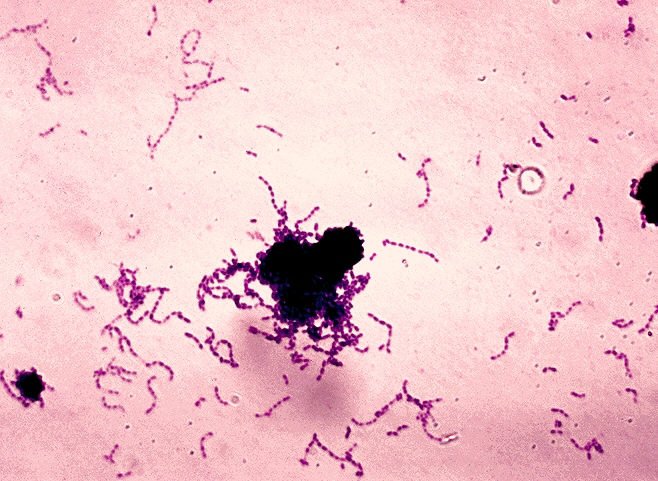
Content Providers(s): Streptococcus mutans
Transwiki approved by: w:en:User:Dmcdevit, Wikimedia Commons, Public domain
Get the weekly research newsletter
Stay current with scholarly research without reading academic papers — one filtered digest, every Friday.