Tag: Astrophysics & Stellar Science

  • First passage model fits the Large Magellanic Cloud corona better

    What the study found

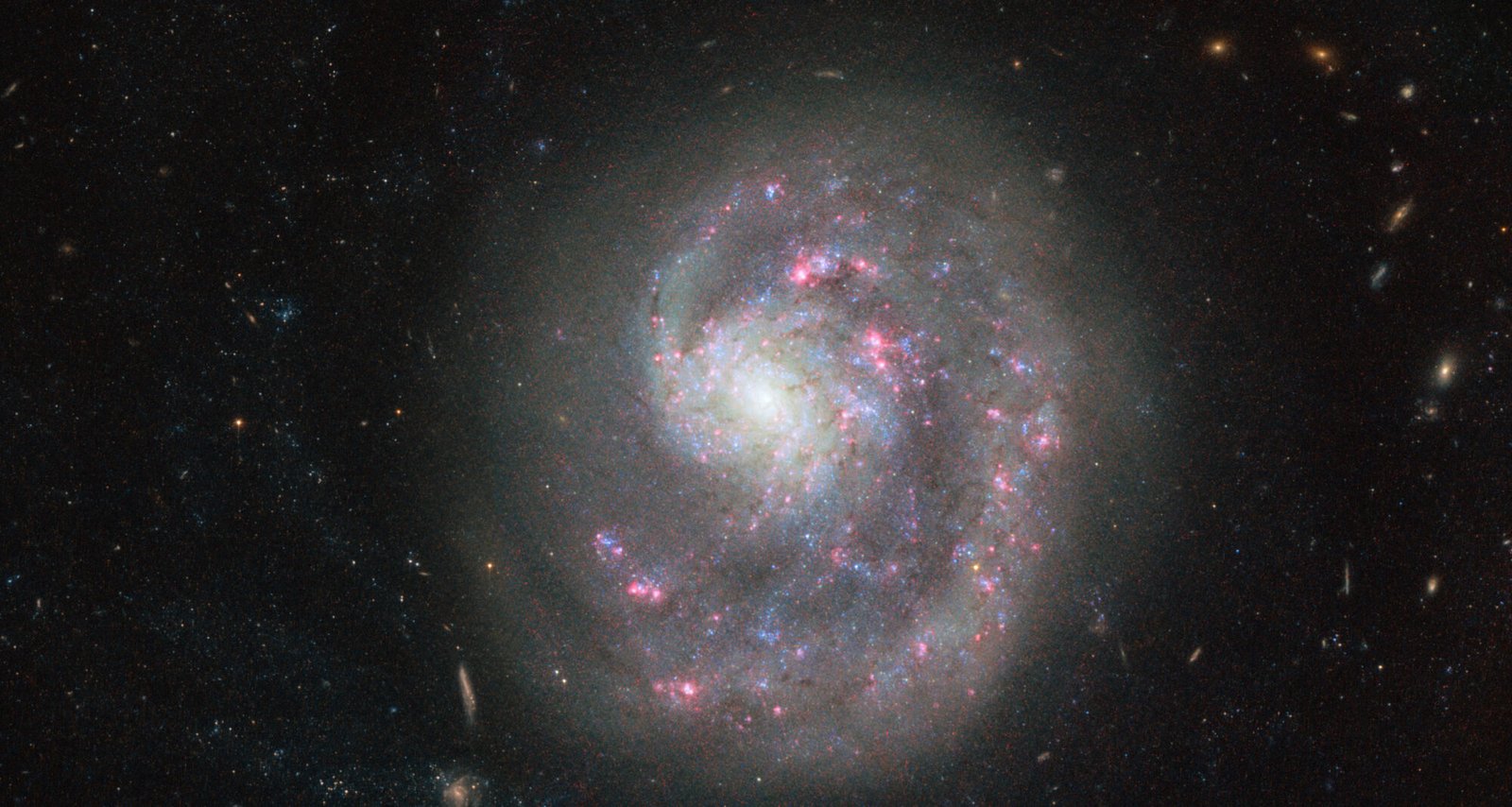
    The study found that the Large Magellanic Cloud’s gaseous halo, or corona, is more consistent with a first passage orbit than a second passage orbit around the Milky Way. In the simulations, the first passage case matched the present-day observed velocity and column density profiles better than the second passage case.

    Why the authors say this matters

    The authors suggest that the size and gas properties of the Large Magellanic Cloud corona can help distinguish between first and second passage orbital histories. They conclude that the present-day gas properties of the Large Magellanic Cloud’s circumgalactic medium strongly disfavor a second passage trajectory.

    What the researchers tested

    The researchers used constrained idealized simulations of the Large Magellanic Cloud and Milky Way interaction. They combined live circumgalactic gas particles with analytic dark matter potentials and evolved them along previously published orbital trajectories for first and second passage scenarios.

    What worked and what didn't

    The first passage model reproduced the observed velocity profile and column density profile of the present-day Large Magellanic Cloud corona. The second passage model produced present-day velocities and column densities that were significantly lower than observations, and it gave a much smaller truncation radius than the first passage case.

    What to keep in mind

    The abstract describes constrained idealized simulations rather than direct observations of the full interaction history. It does not provide broader limitations beyond the comparison of the two orbital models.

    • The Large Magellanic Cloud corona matches a first passage orbital history better than a second passage one.
    • The first passage model reproduces the observed velocity and column density profiles of the corona.
    • The second passage model yields gas velocities and column densities that are significantly lower than observed.
    • Estimated truncation radii are 16.6 ± 0.5 kpc for first passage and 5.7 -2.2 +1.8 kpc for second passage.
    • The authors conclude that a second passage trajectory is strongly disfavored.
  • Review links stellar mergers to diverse outcomes

    What the study found

    The review concludes that stellar mergers can lead to a wide range of outcomes, including blue straggler stars, spectacular transients, very massive stars, strong magnetic fields, and rapidly rotating merger products. It also notes that mergers of main sequence stars often fully rejuvenate, while mergers involving post-main sequence stars can create interior structures unlike those reachable through single-star evolution.

    Why the authors say this matters

    The authors suggest these merger products may help explain long-lived blue supergiants, SN 1987A-like events, interacting and superluminous supernovae, and the formation of very massive black holes. The study also suggests merged stars may be the origin of some magnetic OBA stars and their descendants, highly magnetic white dwarfs, and neutron stars.

    What the researchers tested

    This is a review article focused on mergers from binary evolution and stellar collisions, excluding mergers involving compact objects. The authors review how mergers form, the physics and outcomes of the merger process, the later evolution and final fates of merged stars, and how these ideas relate to observations.

    What worked and what didn't

    Mergers of main sequence stars often appear to fully rejuvenate and develop interior structures similar to genuine single stars. In contrast, post-main-sequence mergers can produce structures that single-star evolution cannot make, and these products may become long-lived blue supergiants or end as such stars. The abstract also states that merger products initially rotate rapidly, but several mechanisms can quickly spin them down, so they may be slow rotators for most of their evolution.

    What to keep in mind

    The article is a review, so the abstract summarizes themes and conclusions rather than reporting one new experiment. It does not provide detailed methods, sample sizes, or quantitative results in the available summary, and it does not cover mergers involving compact objects.

    • Main-sequence star mergers often fully rejuvenate and can resemble ordinary single stars internally.
    • Post-main-sequence mergers can create stellar structures that single-star evolution cannot produce.
    • Some merger products may become long-lived blue supergiants and may be linked to SN 1987A-like events and other supernova types.
    • Stellar mergers are described as a possible origin of strong magnetic fields in some stars and their remnants.
    • Merger products start off rotating rapidly, but they may spin down quickly and become slow rotators.
  • Changing-look AGNs mostly match typical host-galaxy scaling relations

    Changing-look AGNs mostly match typical host-galaxy scaling relations

    What the study found

    The study found that most changing-look active galactic nuclei, or CL-AGNs, do not appear to be driven by variable obscuration, and that they generally follow the black hole-to-host-galaxy relations seen in inactive galaxies. The authors also report no evidence that several host-galaxy properties differ from those of type 2 active galactic nuclei.

    Why the authors say this matters

    The authors suggest these results mean CL-AGNs likely reside in typical active galactic nucleus host galaxies and that their extreme variability is probably unrelated to host-galaxy environment. They conclude this supports the idea that CL-AGNs are not a distinct population, but instead represent a phase of normal active galactic nucleus activity.

    What the researchers tested

    The researchers studied 23 CL-AGNs identified by the Sloan Digital Sky Survey V, using intermediate-resolution spectroscopy from the Very Large Telescope/X-shooter and Gemini-N/GMOS. They analyzed the Mg ii λ 2798 emission line and examined host-galaxy properties including stellar mass, age, young stellar fraction, and star formation rate.

    What worked and what didn't

    The Mg ii λ 2798 line analysis showed that the majority of the sources cannot be explained by variable obscuration. The CL-AGNs roughly followed the M BH–σ* and M BH–M* relations of inactive galaxies, with a median black hole-to-stellar mass ratio of 0.38%. The study found no evidence of differences in the listed stellar population properties compared with type 2 AGNs in SDSS.

    What to keep in mind

    The abstract does not describe detailed limitations beyond the sample size and the specific set of galaxies studied. The findings are based on 23 CL-AGNs observed with the stated instruments, so the summary is limited to that sample.

    • The study examined 23 changing-look active galactic nuclei identified by SDSS-V.
    • Most of the sources could not be driven by variable obscuration, based on Mg ii λ 2798 analysis.
    • The sample roughly followed black hole scaling relations for inactive galaxies.
    • No evidence was found for differences in stellar mass, age, young stellar fraction, or star formation rate versus type 2 AGNs in SDSS.
    • The authors conclude CL-AGNs may represent a phase of normal active galactic nucleus activity.
  • Near-ultraviolet blue spirals show outer-disk star formation

    Near-ultraviolet blue spirals show outer-disk star formation

    What the study found

    The study found that the main differences between near-ultraviolet-blue and near-ultraviolet-red spiral galaxies are concentrated in their outer disks, between about 1 and 3 effective radii. The authors report that near-ultraviolet-red spirals appear fully quenched, while near-ultraviolet-blue spirals have quenched bulges and inner disks but star-forming outer disks.

    Why the authors say this matters

    The authors say this helps explain the complicated formation processes of disk galaxies, which are galaxies with flattened, rotating disks of stars and gas. They suggest the findings are consistent with near-ultraviolet-blue spirals having gained fresh fuel for star formation through interaction or merging with gas-rich galaxies, or by accreting surrounding hydrogen gas.

    What the researchers tested

    The researchers compared near-ultraviolet-blue and near-ultraviolet-red spiral galaxies selected from a parent sample of optically red spirals with stellar masses above 10^10.5 solar masses at redshift 0.02 to 0.07. They used optical data from the Sloan Digital Sky Survey and ultraviolet data from the Galaxy Evolution Explorer, and they analyzed images, surface brightness profiles, star formation main-sequence positions, color profiles, and disk mass-size relations.

    What worked and what didn't

    The image and surface brightness analyses showed that the differences between the two spiral types mainly occur in the outer disks, and the contrast is larger in near-ultraviolet light than in optical bands. The star formation main-sequence diagram and color profiles suggest full quenching in near-ultraviolet-red spirals, while near-ultraviolet-blue spirals retain outer-disk star formation; the disk mass-size relations indicate that, at a given disk mass, near-ultraviolet-blue spirals have optical disks about 1.20 times larger.

    What to keep in mind

    The available summary does not describe detailed limitations beyond the selected sample of optically red spirals at the stated mass and redshift range. The abstract also does not provide direct tests of the proposed fueling scenarios, so those are presented as consistency with the observed environments and morphologies.

    • The strongest differences between the spiral-galaxy groups appear in the outer disks, around 1 to 3 effective radii.
    • Near-ultraviolet-red spirals are described as fully quenched.
    • Near-ultraviolet-blue spirals have quenched bulges and inner disks but star-forming outer disks.
    • At the same disk mass, near-ultraviolet-blue spirals have optical disks about 1.20 times larger.
    • The authors say the environments and optical morphologies fit scenarios involving gas-rich interactions, mergers, or hydrogen-gas accretion.
  • Supermassive stars match JWST little red dot spectra

    What the study found

    The study found that synthetic spectra from a model supermassive star can match the spectral signatures of some of JWST’s little red dots. The authors report that the model reproduces the luminosity and several defining spectral features of these compact, high-redshift sources.

    Why the authors say this matters

    The authors conclude that this offers a self-consistent alternative to multicomponent obscured active galactic nucleus scenarios. They suggest JWST may be observing luminous stages of supermassive black hole progenitors before collapse.

    What the researchers tested

    The researchers performed what they describe as the first quantitative test of whether little red dots are the direct observational manifestation of primordial supermassive stars. They built a first-principles pipeline to generate synthetic spectra for a nonrotating, metal-free supermassive star up to 10^6 solar masses and compared the results with observed little red dot spectra.

    What worked and what didn't

    The model’s luminosity at 4050 Å matched prominent little red dots, and it reproduced the V-shaped Balmer break morphology and the line pattern of strong H beta emission with other Balmer lines in absorption. With wind and macroturbulent broadening, the authors say they matched spectra at redshifts 7.76 and 3.55, including the H beta width of MoM-BH*-1 to within 4%.

    What to keep in mind

    The abstract only describes one model class: a nonrotating, metal-free supermassive star. It also gives a luminosity-dependent observability window, but it does not describe broader limits, uncertainty estimates, or how often this explanation applies across the full little red dot population.

    • The paper argues that synthetic supermassive star spectra can match some JWST little red dot observations.
    • The model reproduces a V-shaped Balmer break and a pattern of H beta emission with other Balmer lines in absorption.
    • The authors report a luminosity match at 4050 Å and a close match to the H beta width of MoM-BH*-1.
    • They present this as an alternative to obscured active galactic nucleus scenarios.
    • The abstract estimates an observability window of about 10^4 years for the most luminous systems.
  • TESS observations reveal active flaring in PM J11183+1347

    What the study found

    The study found that PM J11183+1347, an M dwarf star, is strongly magnetically active and shows rotational changes and frequent flaring. The authors report flare energies from 1.59 × 10^32 to 1.05 × 10^34 erg, with several superflares above 10^33 erg.

    Why the authors say this matters

    The findings indicate that the star’s activity is consistent with strong surface magnetism, including spot-related variability and flare behavior. The authors conclude that the flare frequency pattern and flare-duration relationship support magnetic reconnection as the main process behind the flares.

    What the researchers tested

    The researchers analyzed high-cadence light curves from the Transiting Exoplanet Survey Satellite (TESS) across four sectors. They used periodogram analysis to examine rotational modulation and studied detected flare events to measure their durations, energies, and shapes.

    What worked and what didn't

    They detected 21 flare events lasting 15 to 455 minutes. The light curves showed periods from 4.59 to 6.34 days, and the flare morphologies included classical single-peaked flares, complex multipeaked flares, and peak-bump structures.

    What to keep in mind

    The abstract does not describe limitations in detail. The reported period range may be attributed to differential rotation and evolving starspots, but the abstract presents this as a possible explanation rather than a confirmed one.

    • PM J11183+1347 is described as an active dMe-type M dwarf at 24.8 pc.
    • TESS light curves from four sectors showed rotational periods between 4.59 and 6.34 days.
    • The study detected 21 flare events with energies from 1.59 × 10^32 to 1.05 × 10^34 erg.
    • Several flares were classified as superflares with energies above 10^33 erg.
    • The flare frequency distribution followed a power law with index α = 1.57 ± 0.18.
    • Flare duration and energy were strongly correlated, with a correlation of about 0.96.
  • SDSS-V maps distant, metal-poor Milky Way halo stars

    What the study found

    The study describes a pipeline for the SDSS-V Milky Way halo survey that estimates stellar parameters, metallicities, alpha abundances, and distances from spectra, photometry, and parallaxes. The authors report that the resulting BOSS-MINESweeper catalog was validated and can be used to identify unusual stars, map distant halo substructures, and measure large-scale Milky Way dynamics.

    Why the authors say this matters

    The authors suggest this catalog provides new scientific capabilities for studying the Milky Way halo, including finding chemically peculiar stars and mapping distant structure. They also state that the publicly available catalog will be updated in future data releases.

    What the researchers tested

    The researchers described the stellar parameter pipeline used for the SDSS-V halo survey. It simultaneously models spectra, broadband photometry, and parallaxes to infer stellar properties, and the catalog was checked across a wide range of stellar parameters and metallicities using star clusters and comparisons with high-resolution spectroscopic surveys.

    What worked and what didn't

    The catalog was validated across a broad range of stellar parameters and metallicities. The abstract says it supports identifying the most chemically peculiar stars in the Galaxy, discovering and mapping distant halo substructures, and measuring Milky Way dynamics on large scales; it does not describe any failed tests or specific limitations in those capabilities.

    What to keep in mind

    The summary available here does not provide detailed limitations, uncertainties, or failure cases beyond the validation described. The paper is focused on the SDSS-V halo survey and its DR19 BOSS-MINESweeper catalog, so the described results apply to that dataset and survey context.

    • SDSS-V is carrying out the first all-sky low-resolution spectroscopic survey of the Milky Way's stellar halo.
    • The pipeline models spectra, broadband photometry, and parallaxes together to estimate stellar parameters, metallicities, alpha abundances, and distances.
    • The BOSS-MINESweeper catalog was validated with star clusters and high-resolution spectroscopic surveys.
    • The dataset can identify chemically peculiar stars and map distant halo substructures.
    • The authors say it can also measure Milky Way dynamics on the largest scales.
  • Vertical flows are detected in most protoplanetary disks

    What the study found

    The study found vertical gas motions in most of the 14 protoplanetary disks it examined. The detected patterns included oscillatory up-and-down flows, which the authors link to instabilities, and transitions from downward to upward motion, which they interpret as the bases of disk winds.

    Why the authors say this matters

    The authors say these vertical gas flows are important because they are natural outcomes of protoplanetary disk processes and play a critical role in the earliest stages of planet formation. They also conclude that deep, high-spectral-resolution line data can reveal vertical flows that are otherwise difficult to identify.

    What the researchers tested

    The researchers analyzed 14 disks in the exoALMA Large Program using the 12 CO J = 3–2 and 13 CO J = 3–2 emission lines. They modeled the Keplerian velocity field, which is the expected circular orbital motion in a disk, with discminer, then extracted line-of-sight velocity residuals to measure radial and vertical gas motion.

    What worked and what didn't

    Vertical motions were detected in most disks, and in most cases the velocity amplitudes were only a few tens of m s−1. Two disks, MWC758 and CQ Tau, showed two spiral velocity features that the authors interpret as vertical velocities reaching up to about 350 m s−1, and fast upward motions up to 500 m s−1 were also detected in the outer disk of MWC758.

    What to keep in mind

    The authors note that strong molecular winds appear to be relatively rare in 12 CO and 13 CO. They also report that the overall velocity structure is highly complex, which prevents identifying one dominant physical mechanism across all disks, and they say further theoretical investigation is needed.

    • Vertical gas motions were found in most of the 14 disks studied.
    • Two recurring patterns were identified: oscillatory up/down flows and downward-to-upward transitions.
    • Most measured velocities were only a few tens of m s−1.
    • MWC758 and CQ Tau showed spiral velocity features interpreted as much faster vertical motion.
    • Synthetic observations from magnetohydrodynamic simulations supported the method’s reliability.
    • The authors say the disks’ complex velocity structure prevents a single dominant mechanism from being identified.
  • TransFit-CSM models interaction-powered transients with physically consistent fits

    What the study found

    The study introduces TransFit-CSM, a fast and physically consistent framework for modeling interaction-powered transients, which are bright astronomical events powered by interaction between ejecta and circumstellar medium (CSM, material around a star). It reproduces an early dark phase, a diffusion-mediated rise and peak, and a post-interaction cooling tail.

    Why the authors say this matters

    The authors conclude that the framework is Bayesian-ready and can constrain physical parameters of the ejecta and CSM from bolometric or joint multiband light curves. They also suggest it bridges simple analytic prescriptions and radiation-hydrodynamic simulations, and that it enables population-level inference for current and upcoming time-domain surveys.

    What the researchers tested

    The researchers built a model that self-consistently couples ejecta–CSM shock dynamics to radiative diffusion from a moving heating boundary tied to the shocks. They numerically solved the mass–momentum equations for the forward and reverse shocks together with the diffusion equation in the unshocked CSM, and applied the framework to SN 2006gy and SN 2010jl.

    What worked and what didn't

    TransFit-CSM reproduced the canonical sequence of an early dark phase, a diffusion-mediated rise and peak, and a post-interaction cooling tail. The abstract says applications to SN 2006gy and SN 2010jl gave accurate fits and physically interpretable posteriors, and it also says the framework clarifies why Arnett-like peak rules break down in optically thick CSM.

    What to keep in mind

    The abstract does not describe specific numerical limits, uncertainties, or failure cases beyond noting that Arnett-like peak rules break down in optically thick CSM. Further limitations are not described in the available summary.

    • TransFit-CSM is presented as a fast, physically consistent framework for interaction-powered transients.
    • The model couples shock dynamics with radiative diffusion from a moving heating boundary tied to the shocks.
    • It reproduces an early dark phase, a diffusion-mediated rise and peak, and a post-interaction cooling tail.
    • Applications to SN 2006gy and SN 2010jl produced accurate fits and physically interpretable posteriors.
    • The authors say the framework can constrain ejecta and CSM parameters from bolometric or multiband light curves.
  • Large protoplanetary disks show widespread non-Keplerian gas deviations

    What the study found

    The study found that all 15 protoplanetary disks in the exoALMA sample show large-scale deviations from smooth Keplerian rotation, meaning the gas does not move exactly as expected in a simple circular orbit pattern. The deviations appear in several forms, including spiral-like structures, arc- or ring-like features, and patterns linked to changes in the emitting surface height.

    Why the authors say this matters

    The authors say these gas-kinematic deviations are key tracers of physical processes and of the presence of protoplanets within disks. They conclude that the 2D atlas suggests kinematic substructures are ubiquitous in large protoplanetary disks with ages of a few million years.

    What the researchers tested

    The researchers used CO (J = 3–2) data from the exoALMA Large Program, which includes 15 disks. They built two-dimensional maps of centroid velocity, line width, and peak intensity, then extracted non-Keplerian deviations by subtracting smooth Keplerian models.

    What worked and what didn't

    The approach revealed a first systematic and uniform overview of 2D gas substructures across the full exoALMA sample. Nonaxisymmetric spiral-arm features were detected or suggested in five disks: CQ Tau, MWC 758, HD 135344B, HD 34282, and SY Cha; these were preferentially found in Herbig Ae/Fe systems. Some other sources, including J1852, PDS 66, and V4046 Sgr, showed noticeable deviations but appeared to be dynamically quieter.

    What to keep in mind

    The abstract does not describe detailed limitations beyond the observational requirements. The authors note that the atlas is based on observations with sufficient sensitivity, moderate-to-high spatial resolution of about 20 au, and high-velocity resolution of about 0.1 km s−1, so the findings are scoped to data of that quality and to the 15-disk sample.

    • All 15 disks in the exoALMA sample showed large-scale deviations from smooth Keplerian rotation.
    • The deviations included spiral-like, arc-like, ring-like, and emitting-surface-height patterns.
    • Spiral-arm features were detected or suggested in five disks: CQ Tau, MWC 758, HD 135344B, HD 34282, and SY Cha.
    • The spiral-like features were preferentially found in Herbig Ae/Fe systems.
    • Some disks, including J1852, PDS 66, and V4046 Sgr, showed deviations but seemed dynamically quieter.
    • The atlas used CO (J = 3–2) data, 2D kinematic maps, and subtraction of smooth Keplerian models.