Author: editor@focalinterest.com

  • Post-processed wind-speed ensembles outperformed raw forecasts

    What the study found

    The study found that post-processed wind-speed ensemble forecasts generally performed better than raw ensemble forecasts. It also found that spatial resolution mattered more than ensemble size, and that adding high-resolution members to low-resolution forecasts could improve skill, especially when more high-resolution members were included.

    Why the authors say this matters

    The authors suggest this matters because forecast skill depends on both resolution and ensemble composition, and because post-processing can reduce differences among forecast configurations. The study indicates that, in some cases, adding members does not necessarily improve skill, so the balance between resolution and ensemble size is important.

    What the researchers tested

    The researchers compared raw and post-processed medium-range and extended-range wind-speed ensemble forecasts from the European Centre for Medium-Range Weather Forecasts at 9 km and 36 km horizontal resolutions. They used an ensemble model output statistic approach for calibration with three spatial training data selection techniques, and they examined a 150-member dual-resolution combination as well as mixtures made by adding 1, 2, 4, 8, 16, or 32 high-resolution members to a 50-member low-resolution forecast.

    What worked and what didn't

    In general, all post-processed forecasts outperformed the raw ensemble predictions in probabilistic calibration and point forecast accuracy. Post-processing also reduced differences among the various forecast configurations. The study reports that augmenting a sufficiently large high-resolution ensemble with low-resolution predictions did not necessarily improve forecast skill, while incorporating high-resolution members into low-resolution ensemble forecasts showed clear benefit, with the largest gains in configurations with the most high-resolution members.

    What to keep in mind

    The abstract does not describe limitations in detail beyond the specific forecast systems and configurations studied. The findings are limited to the wind-speed ensemble forecasts, resolutions, and post-processing methods described in the study.

    • Post-processing improved probabilistic calibration and point forecast accuracy for the wind-speed ensembles.
    • Forecast differences among configurations became smaller after calibration.
    • Spatial resolution was reported to be more important than ensemble size.
    • Adding low-resolution members to high-resolution forecasts did not necessarily improve skill.
    • Adding high-resolution members to low-resolution forecasts produced clear gains, especially with more high-resolution members.
  • Sbp1 limits autophagy during hydroxyurea stress

    What the study found

    The study found that the translation repressor Sbp1 acts as a negative regulator of autophagy during hydroxyurea-induced replication stress. It also found that Sbp1’s behavior in cytoplasmic granules and its effect on autophagy depend on an RGG motif.

    Why the authors say this matters

    The authors conclude that their findings suggest a regulatory link between granule-mediated mRNA sequestration, translation control of autophagy factors, and the cellular response to genotoxic stress. They also suggest that altered autophagy is linked to genome maintenance through changes in DNA repair choice.

    What the researchers tested

    The researchers examined how Sbp1 behaves in cells treated with hydroxyurea, a compound that causes replication stress. They tested Sbp1 localization, the translation of autophagy genes, levels of autophagy, and the effect of Sbp1 overexpression or loss on DNA repair pathway choice.

    What worked and what didn't

    When cells lost Sbp1, the translation of ATG1, ATG2, and ATG9 increased, and both selective macroautophagy/autophagy and bulk autophagy increased. When Sbp1 was overexpressed, both forms of autophagy were suppressed, and DNA repair shifted toward non-homologous end joining (NHEJ).

    What to keep in mind

    The abstract does not describe the full experimental details, sample size, or any limitations. The findings are limited to hydroxyurea-induced replication stress and the specific factors named in the abstract.

    • Sbp1 localizes to reversible, mRNA-containing cytoplasmic granules after hydroxyurea treatment.
    • Loss of Sbp1 increases translation of the autophagy genes ATG1, ATG2, and ATG9.
    • Sbp1 deletion is associated with increased selective macroautophagy/autophagy and increased bulk autophagy.
    • Sbp1 overexpression suppresses both selective and bulk autophagy.
    • Sbp1 overexpression shifts DNA repair toward non-homologous end joining.
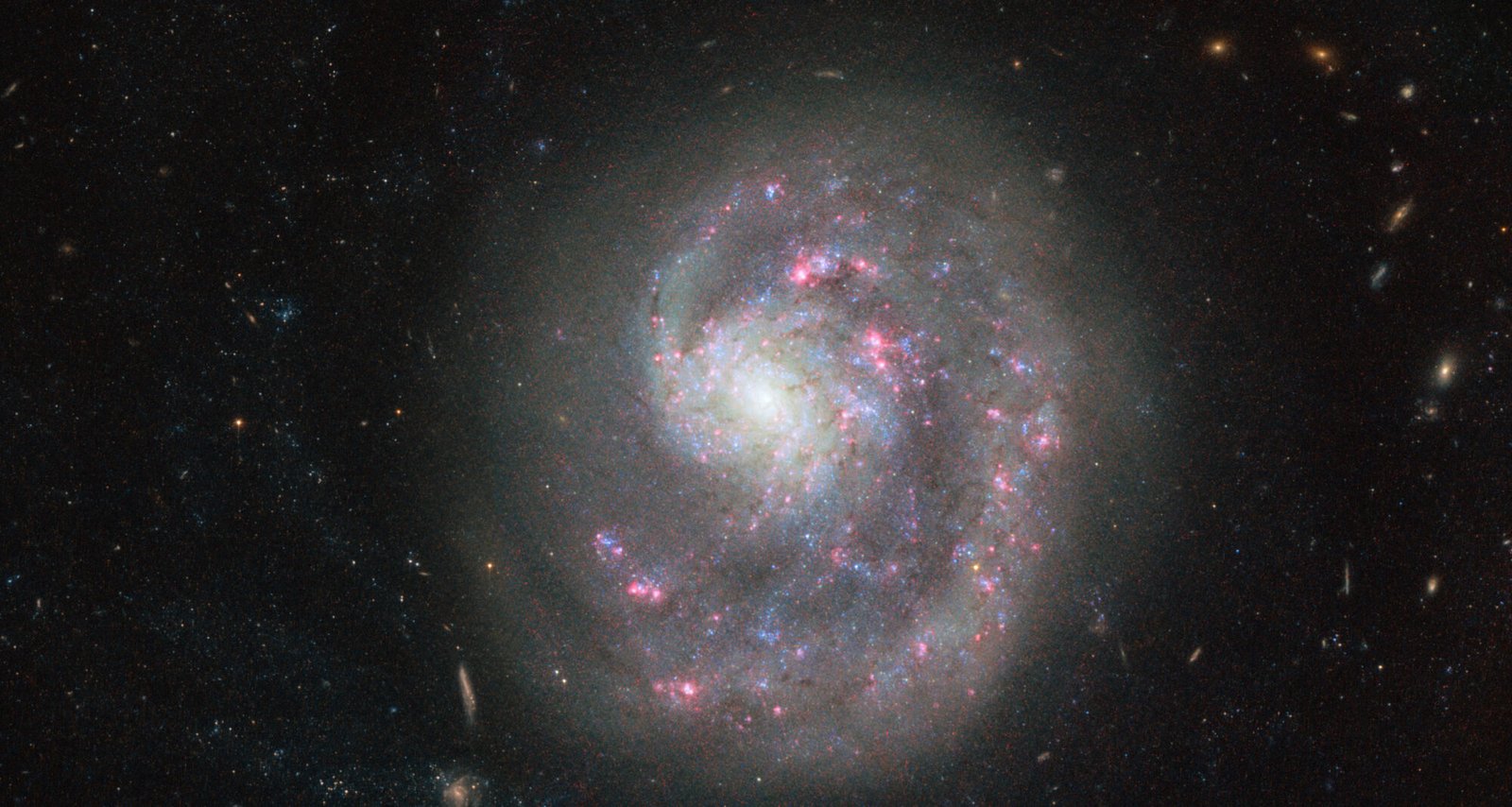
  • Near-ultraviolet blue spirals show outer-disk star formation

    Near-ultraviolet blue spirals show outer-disk star formation

    What the study found

    The study found that the main differences between near-ultraviolet-blue and near-ultraviolet-red spiral galaxies are concentrated in their outer disks, between about 1 and 3 effective radii. The authors report that near-ultraviolet-red spirals appear fully quenched, while near-ultraviolet-blue spirals have quenched bulges and inner disks but star-forming outer disks.

    Why the authors say this matters

    The authors say this helps explain the complicated formation processes of disk galaxies, which are galaxies with flattened, rotating disks of stars and gas. They suggest the findings are consistent with near-ultraviolet-blue spirals having gained fresh fuel for star formation through interaction or merging with gas-rich galaxies, or by accreting surrounding hydrogen gas.

    What the researchers tested

    The researchers compared near-ultraviolet-blue and near-ultraviolet-red spiral galaxies selected from a parent sample of optically red spirals with stellar masses above 10^10.5 solar masses at redshift 0.02 to 0.07. They used optical data from the Sloan Digital Sky Survey and ultraviolet data from the Galaxy Evolution Explorer, and they analyzed images, surface brightness profiles, star formation main-sequence positions, color profiles, and disk mass-size relations.

    What worked and what didn't

    The image and surface brightness analyses showed that the differences between the two spiral types mainly occur in the outer disks, and the contrast is larger in near-ultraviolet light than in optical bands. The star formation main-sequence diagram and color profiles suggest full quenching in near-ultraviolet-red spirals, while near-ultraviolet-blue spirals retain outer-disk star formation; the disk mass-size relations indicate that, at a given disk mass, near-ultraviolet-blue spirals have optical disks about 1.20 times larger.

    What to keep in mind

    The available summary does not describe detailed limitations beyond the selected sample of optically red spirals at the stated mass and redshift range. The abstract also does not provide direct tests of the proposed fueling scenarios, so those are presented as consistency with the observed environments and morphologies.

    • The strongest differences between the spiral-galaxy groups appear in the outer disks, around 1 to 3 effective radii.
    • Near-ultraviolet-red spirals are described as fully quenched.
    • Near-ultraviolet-blue spirals have quenched bulges and inner disks but star-forming outer disks.
    • At the same disk mass, near-ultraviolet-blue spirals have optical disks about 1.20 times larger.
    • The authors say the environments and optical morphologies fit scenarios involving gas-rich interactions, mergers, or hydrogen-gas accretion.
  • Douglas–Rachford algorithms converge on Hadamard manifolds

    What the study found

    The study presents inertial and non-inertial Douglas–Rachford algorithms for minimizing the sum of two geodesically convex functions on Hadamard manifolds. It also introduces parallel Douglas–Rachford-type algorithms for problems with multiple summands, including applications to generalized Heron problems.

    Why the authors say this matters

    The authors say the goal is to improve the convergence of the Douglas–Rachford algorithm on Hadamard manifolds, which are spaces of nonpositive curvature. The study suggests this is relevant for minimizing functionals with multiple terms and for generalized Heron problems on these manifolds.

    What the researchers tested

    The researchers studied two algorithm types, inertial and non-inertial, under suitable assumptions on the algorithmic parameters and the geodesic convexity of the objective functions. They based the convergence analysis on fixed-point theory for nonexpansive operators and also examined convergence rates.

    What worked and what didn't

    According to the abstract, both algorithm types have convergence analysis under the stated assumptions. The paper also reports convergence rates for the two methods and presents numerical experiments for generalized Heron problems to demonstrate effectiveness.

    What to keep in mind

    The abstract does not give the detailed assumptions, numerical results, or specific rate values. It also does not describe any failures or compare performance between the inertial and non-inertial methods.

    • The paper develops inertial and non-inertial Douglas–Rachford algorithms on Hadamard manifolds.
    • The target problem is minimizing the sum of two geodesically convex functions.
    • The authors provide convergence analysis and study convergence rates under suitable assumptions.
    • Parallel Douglas–Rachford-type algorithms are introduced for multiple-summand functionals.
    • The methods are applied to generalized Heron problems, with numerical experiments reported.
  • Higher PHDI adherence linked to better diet quality in Turkish adults

    What the study found

    Adults in this Turkish sample with higher adherence to the Planetary Health Diet Index (PHDI, a score for how closely a person's diet matches the EAT-Lancet Planetary Health Diet) tended to have better diet quality. The study also reported links between diet quality and environmental footprints.

    Why the authors say this matters

    The authors conclude that the Planetary Health Diet may support environmental sustainability alongside higher diet quality while reducing environmental burdens. They frame this as important because data on this diet framework in Türkiye have been limited.

    What the researchers tested

    The researchers studied 571 adults aged 18 to 64 from a family health center in Ağrı province, Türkiye. They used a single 24-hour dietary recall, calculated PHDI for adherence to the Planetary Health Diet, assessed diet quality with the Healthy Eating Index-2020 (HEI-2020), and estimated carbon footprint and water footprint using the SU-EATABLE LIFE and SHARP-ID databases.

    What worked and what didn't

    The mean PHDI score was 51.9 and the mean HEI-2020 score was 47.5. Participants in the highest PHDI quintile had higher odds of better diet quality than those in the lowest quintile, and each unit increase in PHDI was associated with a higher HEI score. Carbon footprint was inversely associated with HEI, while water footprint was positively associated with HEI.

    What to keep in mind

    This was a cross-sectional study, so it describes associations rather than cause and effect. The sample came from one family health center in one province, and the abstract does not describe additional limitations.

    • The study included 571 adults aged 18 to 64 in Ağrı province, Türkiye.
    • Higher PHDI adherence was associated with better HEI-2020 diet quality scores.
    • The highest PHDI quintile had significantly higher odds of better diet quality than the lowest quintile.
    • Carbon footprint was inversely associated with HEI, while water footprint was positively associated with HEI.
    • The study used a single 24-hour dietary recall and estimated environmental footprints from published databases.
  • Label noise changes hidden representations in neural networks

    What the study found

    The study found that the information content of hidden neural network representations changes with label noise and network size. It also found a double descent pattern in this information content as the number of network parameters changes.

    Why the authors say this matters

    The authors conclude that the relationship between information imbalance, a proxy for conditional mutual information, and test error offers a new perspective on generalization. They also suggest that the results show how training objectives shape internal representations.

    What the researchers tested

    The researchers compared hidden representations learned by neural networks of different sizes using the Information Imbalance, which they describe as a computationally efficient proxy for conditional mutual information. They trained the networks on datasets with controlled levels of label noise and examined representations across layers.

    What worked and what didn't

    In the underparameterized regime, representations learned with noisy labels were more informative than those learned with clean labels. In the overparameterized regime, the two were equally informative, and label noise reduced the information content between the penultimate layer and the pre-softmax layer, matching the increase in test error. Representations learned from random labels performed worse than random features when the number of parameters and training samples were scaled proportionally with a fixed ratio.

    What to keep in mind

    The abstract does not describe limitations beyond the studied settings, so the findings should be read as applying to the networks, dataset conditions, and scaling regimes tested here. The summary also does not report details about specific architectures, datasets, or the magnitude of the observed effects.

    • Hidden representations showed a double descent pattern as network size changed.
    • Noisy-label representations were more informative than clean-label ones in the underparameterized regime.
    • Overparameterized networks produced representations that were equally informative under noisy and clean labels.
    • Label noise lowered information content between the penultimate and pre-softmax layers.
    • Random-label training performed worse than random features under proportional scaling of parameters and samples.
  • Two-dimensional gauge theories show rich phase structure

    What the study found

    The study found that several Abelian gauge theories in 1+1 dimensions, including a U(1) gauge theory coupled to a scalar and a fermion and the two-flavour Schwinger model with different charges, have a surprisingly rich phase diagram as masses change. The authors also studied 2D chiral gauge theories, which are of interest because they can realize symmetric mass generation, where fermions become gapped without breaking chiral symmetries.

    Why the authors say this matters

    The authors present 2D chiral gauge theories as important because they provide a mechanism for symmetric mass generation. The study suggests that understanding these phase structures helps clarify how fermions can become gapped while chiral symmetries remain unbroken.

    What the researchers tested

    The researchers studied the dynamics and phase structure of Abelian gauge theories in 1+1 dimensions. They examined a U(1) gauge theory coupled to a scalar and a fermion, the two-flavour Schwinger model with different charges, and then moved on to 2D chiral gauge theories.

    What worked and what didn't

    The theories considered exhibited both c = 1 and c = 1/2 critical lines or points, where c refers to the central charge used to label critical behavior in two-dimensional field theory. The abstract does not say that any specific theory failed; it reports that the phase diagrams were rich and that the chiral gauge theories are connected to symmetric mass generation.

    What to keep in mind

    The abstract gives only a high-level summary and does not provide detailed methods, model parameters, or full phase diagrams. It also does not describe limitations, so no further caveats are stated in the available summary.

    • Several 1+1-dimensional Abelian gauge theories were found to have rich phase diagrams as masses vary.
    • The theories include a U(1) gauge theory with a scalar and a fermion, and the two-flavour Schwinger model with different charges.
    • The abstract reports c = 1 and c = 1/2 critical lines or points.
    • The study extends to 2D chiral gauge theories associated with symmetric mass generation.
    • Symmetric mass generation is described as fermions becoming gapped without breaking chiral symmetries.
  • Viscoelastic droplets show an elasto-viscous coalescence regime

    What the study found

    The study found a transition from an elasticity-dominated regime to an elasto-viscous regime during the coalescence of concentrated polymer droplets. It also found that common assumptions used to estimate axial curvature are not universal.

    Why the authors say this matters

    The authors conclude that these results advance understanding of droplet coalescence and highlight the role of viscoelastic effects in complex fluids. The study suggests that the behavior of viscoelastic droplets cannot always be described by assumptions used for simpler fluids.

    What the researchers tested

    The researchers studied how two droplets merge, focusing on concentrated polymer droplets with viscoelastic behavior, meaning both elastic and viscous stresses matter. They combined experimental measurements of interface curvature with numerical simulations based on a volume-of-fluid framework and the exponential Phan-Thien-Tanner model.

    What worked and what didn't

    The experiments revealed the transition into an elasto-viscous regime. The numerical simulations reproduced the viscoelastic neck growth in good agreement with the experiments. The abstract says that common assumptions for estimating axial curvature were not universal, but it does not specify which assumptions failed in which cases.

    What to keep in mind

    The summary provides limited detail about the exact experimental conditions and parameter ranges. It also does not describe broader limits, caveats, or whether the findings apply beyond concentrated polymer droplets.

    • A transition was observed from an elasticity-dominated regime to an elasto-viscous regime.
    • The study examined coalescence in concentrated polymer droplets, a viscoelastic fluid system.
    • Interface-curvature measurements showed that common axial-curvature assumptions are not universal.
    • Simulations using a volume-of-fluid framework and the exponential Phan-Thien-Tanner model matched the observed neck growth well.
    • The authors say the findings advance understanding of droplet coalescence and viscoelastic effects in complex fluids.
  • Emotion-adaptive energy nudges improved engagement in a lab study

    What the study found

    The study found that emotionally adaptive energy-feedback nudges were associated with higher positive affect and sustained engagement than a non-adaptive baseline. The adaptive condition also increased exposure to conservation-relevant cues and produced modest gains in self-reported energy awareness.

    Why the authors say this matters

    The authors suggest that digital energy feedback is often limited when it uses static, uniform messages that ignore a user’s emotional context. They conclude that affect-aware adaptation may improve the long-term effectiveness of energy-conservation nudges.

    What the researchers tested

    The researchers proposed an affect-aware, model-free reinforcement learning framework for personalized energy-feedback nudging. The system extended the MAPE-K loop, which is a monitoring-and-adaptation framework, with an Affect–Behavior Decoupling Architecture that processed emotional signals from real-time facial emotion recognition and behavioral cues in parallel.

    What worked and what didn't

    In a simulated smart-home dashboard and a controlled laboratory study, the emotionally adaptive condition outperformed a non-adaptive baseline on positive affect and sustained engagement. It also increased exposure to conservation-relevant cues and led to modest gains in self-reported energy awareness. The abstract says that demonstrating direct impact on energy consumption still requires longitudinal field studies.

    What to keep in mind

    The study was done in a simulated smart-home dashboard and a controlled laboratory setting, so the results are not direct evidence of real-world energy savings. The abstract also notes that longitudinal field studies are needed to show direct impact on energy consumption.

    • Emotionally adaptive energy feedback was linked to higher positive affect and sustained engagement.
    • The system used real-time facial emotion recognition and behavioral cues to choose nudges.
    • The adaptive condition increased exposure to conservation-relevant cues.
    • Self-reported energy awareness rose modestly in the adaptive condition.
    • Direct effects on energy consumption were not demonstrated in this study.
  • Grushin’s reagent enabled difluoromethylation of complex alcohols

    What the study found

    The study found that Grushin’s reagent, a copper(III) trifluoromethyl complex, can be repurposed as a difluorocarbene source for difluoromethylation. The authors report that this worked for diverse alcohols, including complex saccharides and polyols.

    Why the authors say this matters

    The authors say this matters because the difluoromethoxy motif is valuable in pharmaceuticals and materials, while direct difluoromethylation of complex alcohols is difficult. The study suggests the new strategy may help address those limitations.

    What the researchers tested

    The researchers tested a blue light- and acid-mediated difluoromethylation strategy using Grushin’s reagent. They applied it to primary, secondary, and tertiary alcohols with multiple polar functional groups, and they also examined late-stage modification of complex natural products and bioactive molecules.

    What worked and what didn't

    The method showed broad functional group compatibility and was successfully used on complex alcohols and on late-stage modification targets. A notable result was regioselective difluoromethylation of saccharides and polyols, enabled by Me2SnCl2, which acted as both a hydroxyl activator and a source of hydrogen chloride; the abstract does not describe failures in detail.

    What to keep in mind

    The abstract does not provide detailed limitations, optimization constraints, or substrate scope boundaries beyond the examples mentioned. It also does not describe comparative performance against other difluorocarbene sources.

    • Grushin’s reagent was repurposed from a trifluoromethylation agent to a difluorocarbene source.
    • The strategy used blue light and acid to drive difluoromethylation.
    • The method was reported to work on primary, secondary, and tertiary alcohols with multiple polar functional groups.
    • Regioselective difluoromethylation of saccharides and polyols was achieved with Me2SnCl2.
    • The authors report antifungal activity for compounds 3c and 3n.