Author: editor@focalinterest.com

  • Thermostat methods differ in temperature control and energy sampling

    What the study found

    The study found that thermostat algorithms in constant-temperature molecular dynamics simulations do not perform identically. The Nosé-Hoover chain and Bussi velocity rescaling methods gave reliable temperature control, while the Grønbech-Jensen-Farago Langevin scheme was the most consistent for sampling both temperature and potential energy.

    Why the authors say this matters

    The authors conclude that the comparison offers practical guidance for choosing thermostats in classical molecular dynamics simulations. They also say the findings provide useful insights for applications including glass transition, phase separation, and nucleation.

    What the researchers tested

    The researchers carried out a systematic comparison of representative thermostat methods in constant-temperature molecular dynamics. They examined the Nosé-Hoover thermostat, its chain generalization, the Bussi velocity rescaling method, and several Langevin dynamics implementations using a binary Lennard-Jones liquid as a model glass former.

    What worked and what didn't

    The Nosé-Hoover chain and Bussi thermostats provided reliable temperature control, but potential energy showed a pronounced dependence on time step. Among the Langevin methods, the Grønbech-Jensen-Farago scheme gave the most consistent sampling of temperature and potential energy. The abstract also says Langevin dynamics typically costs about twice as much computationally because of random number generation overhead, and that diffusion coefficients decrease systematically as friction increases.

    What to keep in mind

    The summary describes a comparison on a binary Lennard-Jones liquid model glass former, so the results are limited to that setting. The abstract does not describe additional limitations beyond the time-step dependence, computational cost, and friction-related diffusion changes it reports.

    • Nosé-Hoover chain and Bussi thermostats provided reliable temperature control.
    • Potential energy showed a pronounced dependence on time step for some thermostats.
    • The Grønbech-Jensen-Farago Langevin scheme was the most consistent for temperature and potential energy sampling.
    • Langevin dynamics typically required about twice the computational cost.
    • Diffusion coefficients decreased systematically as friction increased.
  • Hausdorff dimension computed for shrinking targets on affine fractals

    What the study found

    The study computes the Hausdorff dimension of a set of points that recur to shrinking geometric targets in certain affine iterated function systems. The authors focus on a representative class of diagonal affine maps introduced by Przytycki and Urbański.

    Why the authors say this matters

    The authors say this work pushes through the complications that make shrinking-target problems in affine systems difficult. They also conclude that the analysis illustrates the challenges of moving beyond affine maps with nice projections and expands the theory of Bernoulli convolutions.

    What the researchers tested

    The researchers studied shrinking target problems in the setting of iterated function systems, where points return infinitely many times to a sequence of shrinking balls. They examined affine maps rather than similarity maps, and their analysis split into multiple sub-cases depending on the target center and the relative sizes of the targets and the contractions of the maps.

    What worked and what didn't

    The paper reports that the Hausdorff dimension can be computed for the chosen affine system and shrinking-target setting. It also states that the problem is more tractable for similarity maps, while the affine case is more elusive because of geometric and dynamical complications.

    What to keep in mind

    The abstract does not give the detailed formula for the dimension or list the sub-case outcomes. It also does not describe limitations beyond noting that the results apply to a specific class of diagonal affine iterated function systems.

    • The study computes the Hausdorff dimension of a shrinking-target set for certain affine iterated function systems.
    • The systems considered are a pair of diagonal affine maps introduced by Przytycki and Urbański.
    • The analysis depends on the center of the target point and the relative sizes of targets and map contractions.
    • The abstract says affine shrinking-target problems are harder than the similarity-map case.
    • The proofs use and extend theory from Bernoulli convolutions.
  • GraphQLify converted REST APIs with zero type mismatches

    What the study found

    The study found that GraphQLify, an automated framework for moving REST APIs to GraphQL, could convert APIs while preserving end-to-end type safety. It also generated an embedded server that directly invokes API code rather than using a separate adapter server.

    Why the authors say this matters

    The authors say this matters because GraphQL is a schema-based, strongly typed query language that can support efficient client-server communication, and preserving type safety is described as a core advantage of adopting it. They also suggest that avoiding separate adapter servers matters because it removes performance overhead from dynamic request binding and network latency.

    What the researchers tested

    The researchers evaluated GraphQLify on 834 APIs from nine popular open-source projects. They compared it with OASGraph, the current state-of-the-art tool in the abstract, and also measured performance for workflows requiring five sequential API calls.

    What worked and what didn't

    GraphQLify successfully converted 100% of the tested APIs with zero type mismatches. By comparison, OASGraph had a 3.5% failure rate and a 42% type mismatch rate on the same dataset. For five sequential API calls, GraphQLify reduced data-fetching time by a factor of 2 to 4 versus REST.

    What to keep in mind

    The abstract does not describe limitations beyond the reported evaluation setting. The results are based on the specific set of 834 APIs from nine open-source projects and the performance test described in the abstract.

    • GraphQLify is an automated framework for migrating REST APIs to GraphQL.
    • It uses static source code analysis for type inference and generates an embedded server.
    • In the evaluation, it converted 100% of 834 APIs with zero type mismatches.
    • OASGraph had a 3.5% failure rate and a 42% type mismatch rate on the same dataset.
    • For five sequential API calls, GraphQLify cut data-fetching time by a factor of 2 to 4.
  • Certain fault orientations show higher slip tendency near a CO2 storage site

    What the study found

    The study found that NW/SE- and NNW/SSE-oriented faults in the selected area show higher slip tendency, meaning they are more susceptible to slipping under the modeled stress conditions. Among these, some faults were identified as having both above-average slip tendency and potential moment magnitude.

    Why the authors say this matters

    The authors indicate that understanding fault reactivation near underground CO2 storage sites is relevant because such operations may lead to induced seismicity, which may in part be related to nearby faults affected by injection. The study suggests this information can help identify critical focal mechanisms for further wave propagation simulations and estimate a sustainable pore pressure window.

    What the researchers tested

    The researchers built a 3D fault dataset from about 80 2D seismic lines covering 60 years of exploration history in the West Schleswig Block in the German North Sea. They combined this with a previously developed 3D numerical stress model of Germany and performed slip-tendency analysis under normal-faulting and strike-slip stress regimes, with uncertainties treated in stochastic simulations.

    What worked and what didn't

    The fault dataset and stress-model-based analysis identified faults whose orientations were associated with higher slip tendency. The study also extended the procedure to estimate the sustainable pore pressure window and potential moment magnitude in the event of reactivation, and highlighted faults with both above-average slip tendency and potential moment magnitude. The abstract does not report any negative test outcomes or failed methods.

    What to keep in mind

    The abstract does not provide detailed numerical results, and it does not state which specific faults were discussed beyond their general orientations. It also does not describe limitations in detail, though it notes that uncertainties in stress magnitudes, friction coefficients, fault geometry, dynamic weakening factor, and clustering tolerances were included in the simulations.

    • The study examined fault reactivation potential near a proposed CO2 storage site in the German North Sea.
    • NW/SE- and NNW/SSE-oriented faults showed higher slip tendency in the analysis.
    • The researchers used about 80 2D seismic lines to build a 3D fault dataset.
    • Uncertainties in stress, friction, fault geometry, dynamic weakening, and clustering tolerances were modeled stochastically.
    • The procedure was extended to estimate sustainable pore pressure and potential moment magnitude if reactivation occurs.
  • PineAPPL-Matrix interface enables NNLO QCD interpolation grids

    What the study found

    The study reports a new interface between PineAPPL and Matrix for producing fully differential cross sections as interpolation grids. These grids are described as accurate at next-to-next-to-leading order (NNLO, the level of precision in quantum chromodynamics calculations) in QCD and next-to-leading order in electroweak theory.

    Why the authors say this matters

    The authors say this is the first publicly available tool for calculating interpolation grids at NNLO QCD accuracy for a wide set of processes. They also state that interpolation grids allow predictions for arbitrary parton distribution functions (PDFs, which describe how quarks and gluons are distributed inside a proton) and PDF uncertainties without repeating the full calculation.

    What the researchers tested

    The researchers developed an interface between the PineAPPL and Matrix codes and used it to generate interpolation grids. They also made the new Matrix version and the grids produced for the publication available on the Matrix website and on the listed repository.

    What worked and what didn't

    According to the abstract, the interface works for calculating fully differential cross sections as interpolation grids with NNLO QCD and next-to-leading order electroweak accuracy. The abstract also says these grids can be used for global PDF analyses using exact NNLO calculations instead of K-factors, which the authors say have several drawbacks.

    What to keep in mind

    The abstract does not give performance details, validation results, or numerical comparisons. It also does not describe any limitations of the interface beyond noting that the work is presented as a new publicly available tool.

    • A new PineAPPL-Matrix interface produces interpolation grids for fully differential cross sections.
    • The grids are described as accurate at NNLO in QCD and next-to-leading order in electroweak theory.
    • The authors say it is the first publicly available NNLO QCD grid tool for a wide set of processes.
    • The abstract says the grids can be used for predictions with arbitrary PDFs and PDF uncertainties without repeating the full calculation.
    • The authors say exact NNLO calculations are important for global PDF analyses and for future next-to-next-to-next-to-leading order PDF fits.
  • Redshift-space Minkowski tensors match simulations only partially

    What the study found

    The study found that perturbative predictions for two translation-invariant, rank-2 Minkowski tensors in redshift space agree with dark matter simulation measurements only to a qualified degree. It also found that nonperturbative Finger-of-God velocity dispersion effects remain significant at relatively large scales and are especially strong in components parallel to the line of sight.

    Why the authors say this matters

    The authors say the work is meant to connect theoretical predictions for Minkowski tensors, which are shape descriptors used to analyze anisotropy, to cosmological parameters so they can be measured in galaxy surveys. They present this as a way to extend earlier work on Minkowski functionals in real and redshift space and to account for Finger-of-God effects and shot noise.

    What the researchers tested

    The researchers derived ensemble averages for the Minkowski tensors W1^(0,2) and W2^(0,2) for a matter density field that is perturbatively non-Gaussian in redshift space. They used the Edgeworth expansion of the joint probability density function of the field and its derivatives, expressing the averages in terms of cumulants up to cubic order, and then compared these predictions with measurements from dark matter simulations.

    What worked and what didn't

    The theoretical predictions matched simulation measurements well enough to be described as a qualified success. However, the abstract says nonperturbative Finger-of-God effects remain important at scales of R_G less than or equal to about 20 h^-1 Mpc, especially for tensor components parallel to the line of sight.

    What to keep in mind

    The abstract does not describe detailed limitations beyond the statement that perturbation theory is only a qualified success. It also does not provide numerical results beyond the noted scale of R_G less than or equal to about 20 h^-1 Mpc.

    • The paper extends Minkowski tensor analysis to non-Gaussian matter density fields in redshift space.
    • Two translation-invariant, rank-2 Minkowski tensors were derived and compared with dark matter simulations.
    • The authors report a qualified success for perturbation theory.
    • Finger-of-God velocity dispersion remains significant at scales of R_G less than or equal to about 20 h^-1 Mpc.
    • The strongest Finger-of-God effects appear in components parallel to the line of sight.
  • Maternal depressive symptoms were not linked to infant rest-activity patterns

    What the study found

    The study found no statistically significant link between postnatal maternal depressive symptoms and infant rest-activity rhythm measures at six months of age.

    Why the authors say this matters

    The authors suggest these findings support the idea that maternal depression may affect how infant sleep is perceived more than its objective quality. They also say the results reinforce the importance of objective measures and the need for longitudinal studies using combined methods.

    What the researchers tested

    The researchers analyzed data from 179 mother-infant pairs. Maternal depressive symptoms were assessed with the Edinburgh Postnatal Depression Scale (EPDS) after birth and with the Patient Health Questionnaire-9 (PHQ-9) when infants were six months old, and infant rest-activity rhythms were measured with actigraphy, a wearable method for recording movement over time, using nonparametric variables called L5, M10, and RA.

    What worked and what didn't

    After adjusting for infant sex, maternal age, socioeconomic level, maternal race/ethnicity, and gestational age, neither maternal depressive symptom score was significantly associated with the infant rest-activity rhythm variables. The abstract does not report any significant positive or negative associations.

    What to keep in mind

    The abstract describes only one time point for infant rhythm measurement at six months, so it does not show how these patterns may change over time. It also does not provide additional limitations beyond noting that more longitudinal studies using combined methods are needed.

    • No statistically significant association was found between maternal depressive symptoms and infant rest-activity rhythms at six months.
    • The study included 179 mother-infant dyads.
    • Maternal depressive symptoms were measured with the EPDS postpartum and the PHQ-9 at six months.
    • Infant rest-activity rhythms were measured with actigraphy using L5, M10, and RA variables.
    • The authors suggest maternal depression may affect perceived infant sleep more than objective sleep quality.
  • Modular symmetry supports quintessence and de Sitter vacua

    What the study found

    The study found that a modular-invariant scalar potential in heterotic orbifolds can produce a rich set of vacua, including anti-de Sitter minima, unstable de Sitter saddle points, and regions supporting multifield hilltop quintessence. The authors also report that all of their solutions satisfy refined swampland de Sitter bounds, where the swampland conjectures are criteria used in string theory to test whether low-energy models fit with quantum gravity.

    Why the authors say this matters

    The authors conclude that modular symmetry can help guide the construction of controlled, string-motivated quintessence scenarios within consistent effective theories. They also say the topic is relevant because modular invariance constrains effective theories and is important in the context of swampland conjectures and flavour physics.

    What the researchers tested

    The researchers examined a modular-invariant scalar potential arising from heterotic orbifolds, using a string-inspired truncation with two moduli, meaning two parameters that describe the shape or size of the compactified extra dimensions. They studied how the flavour structure and moduli dynamics are shaped by the underlying geometry.

    What worked and what didn't

    They found large regions in moduli space, the space of possible values of the moduli fields, that support multifield hilltop quintessence consistent with observations. They also found anti-de Sitter minima and unstable de Sitter saddle points, but the abstract does not describe any stable de Sitter minimum.

    What to keep in mind

    The analysis is based on a string-inspired two-moduli truncation, so it covers a simplified version of the full theory. The abstract does not give details on the specific observational tests, model parameters, or any limitations beyond this scope.

    • A modular-invariant scalar potential from heterotic orbifolds was studied.
    • The potential showed anti-de Sitter minima and unstable de Sitter saddle points.
    • Large regions in moduli space supported multifield hilltop quintessence consistent with observations.
    • All reported solutions satisfied refined swampland de Sitter bounds.
    • The authors say modular symmetry can help build controlled, string-motivated quintessence scenarios.
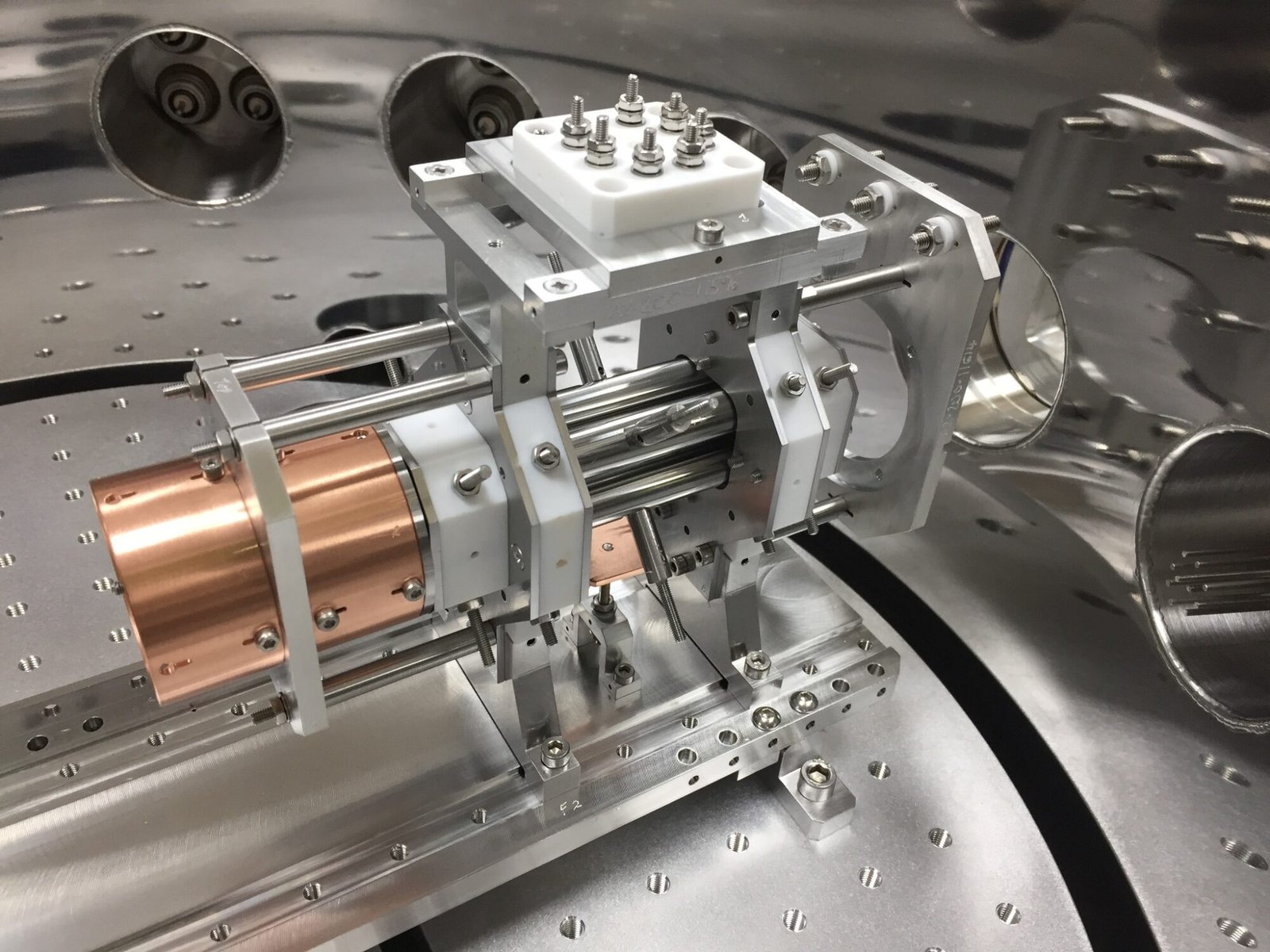
  • Review of reaction control in radiofrequency ion traps

    Review of reaction control in radiofrequency ion traps

    What the study found

    The review concludes that radiofrequency ion traps offer a high degree of control over ion-molecule reaction dynamics. It summarizes ways to control internal quantum states, collision energies, and molecular structure in these systems.

    Why the authors say this matters

    The authors suggest that this control is relevant for studying quantum-state-dependent kinetics, quantum resonance effects, and structure-sensitive reactivity in ion-neutral collisions. They also conclude that it points to future work on full state-to-state reaction mapping, the ultracold quantum regime, and complex and chiral systems.

    What the researchers tested

    This is a review article, not an original experiment. The authors summarize prior techniques for trapping and cooling atomic and molecular ions, including Doppler and resolved-sideband laser cooling, sympathetic cooling, and cryogenic buffer-gas methods.

    What worked and what didn't

    The review describes several strategies that have been used to control reactions: internal cooling, optical pumping, state-selective photoionization, quantum logic spectroscopy, micromotion control, dynamic trapping, combination with molecular beams, isotopic substitution, conformational separation, and isomer-specific ion generation. It also notes applications in studies of quantum-state-dependent kinetics, quantum resonance effects, and structure-sensitive reactivity.

    What to keep in mind

    The article is a review, so its content depends on previously published studies rather than a single new experiment. The abstract does not describe specific quantitative results or detailed limitations beyond noting future challenges such as eliminating micromotion and reaching the ultracold quantum regime.

    • Radiofrequency ion traps are presented as a platform for controlling ion-molecule reaction dynamics.
    • The review covers trapping and cooling methods such as Doppler cooling, resolved-sideband laser cooling, sympathetic cooling, and cryogenic buffer-gas methods.
    • The authors describe ways to control reaction parameters through internal quantum states, collision energies, and molecular structure.
    • Applications discussed include quantum-state-dependent kinetics, quantum resonance effects, and structure-sensitive reactivity.
    • Future challenges include full state-to-state reaction mapping and reaching the ultracold quantum regime without micromotion.
  • Next-to-leading power terms are significant in slepton pair production

    What the study found

    The study finds that next-to-leading power contributions in the threshold variable can be significant for inclusive slepton pair production. It also reports that existing calculations may underestimate the scale error for large slepton masses.

    Why the authors say this matters

    The authors note that cross sections near threshold are sensitive to large logarithmic terms that must be resummed to all orders in perturbation theory. The study suggests that including next-to-leading power effects is important for assessing the reliability of predictions, especially for large slepton masses.

    What the researchers tested

    The researchers evaluated the next-to-leading power contribution in the threshold variable to leading logarithmic accuracy for inclusive slepton pair production at hadron colliders. They also included results for a potential future FCC-hh machine at 85 TeV.

    What worked and what didn't

    The next-to-leading power contributions were found to be significant compared with the next-to-leading logarithmic terms at leading power. The abstract also states that existing calculations underestimate the scale error for large slepton masses.

    What to keep in mind

    The available summary does not describe detailed numerical values, experimental data, or a full comparison across all parameter ranges. It also does not provide additional limitations beyond the focus on leading logarithmic accuracy and the specific collider scenarios studied.

    • Next-to-leading power contributions in the threshold variable can be significant.
    • These contributions were evaluated for inclusive slepton pair production at hadron colliders.
    • Existing calculations may underestimate the scale error for large slepton masses.
    • The study includes results for a future FCC-hh machine at 85 TeV.
    • The work focuses on leading logarithmic accuracy near threshold.