What the study found
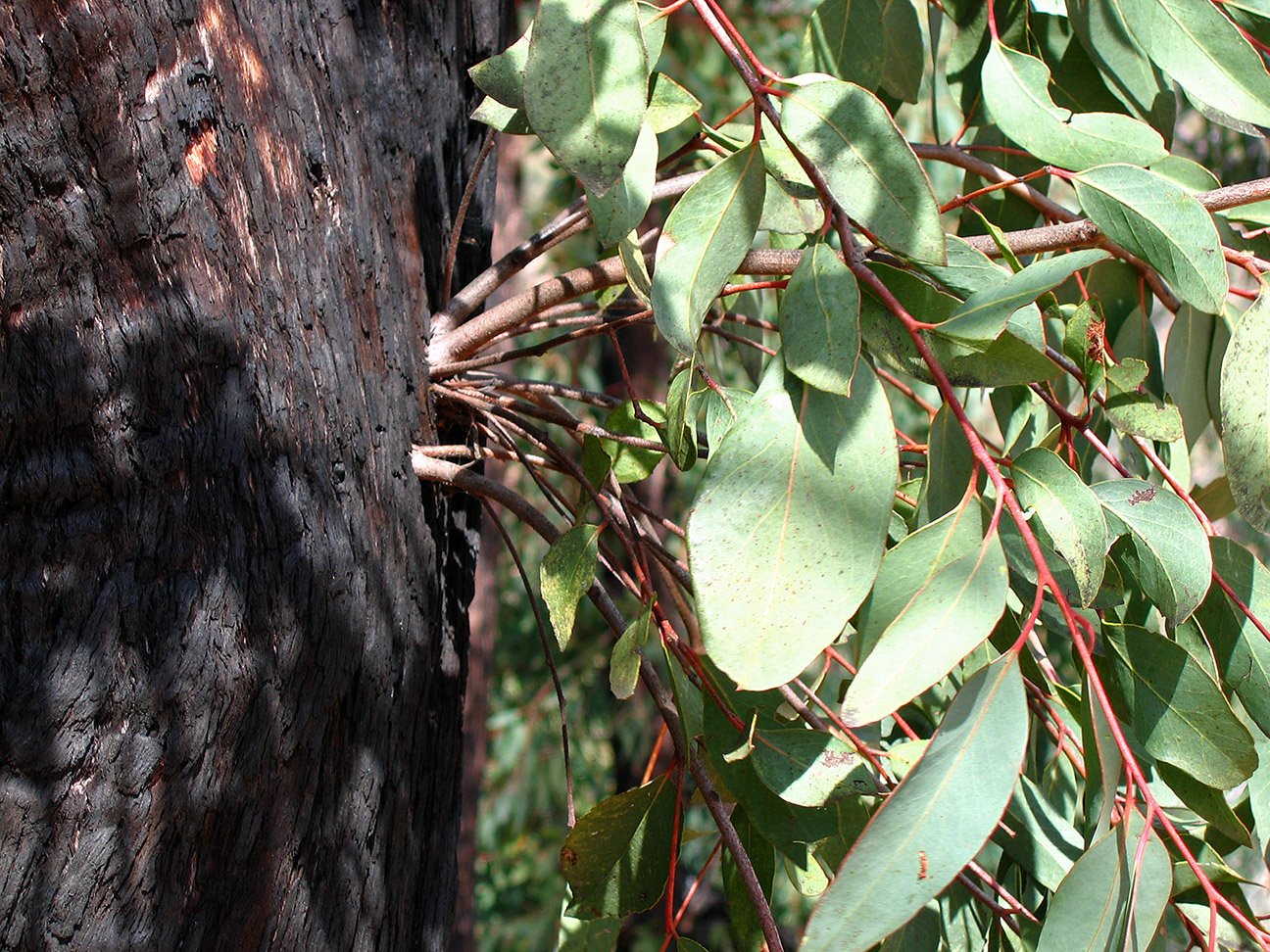
Epicormic regrowth, the new shoots that sprout from living tree tissue after fire, differed chemically from mature foliage. The pattern depended on species and subgenus, and the suitability of this regrowth for leaf-eating animals was highly context-dependent.
Why the authors say this matters
The authors suggest that post-fire food availability for arboreal folivores, such as koalas and southern greater gliders, depends not just on whether foliage returns quickly, but on its chemistry. They conclude that forests with a mix of resprouting eucalypt species may provide enough nutrition to support these animals during recovery.
What the researchers tested
The researchers sampled Eucalyptus foliage in mixed-species eucalypt forests dominated by monocalypt and symphyomyrtle subgenera in southeastern Australia. They compared leaves collected a year before and after the 2019/20 Black Summer bushfires to see how epicormic leaf chemistry differed from mature leaves and whether the regrowth seemed nutritionally suitable for arboreal folivores.
What worked and what didn't
Epicormic leaves generally had higher nitrogen concentrations than mature leaves, but not necessarily higher available nitrogen. Subgenus-specific plant secondary metabolite (PSM, herbivore-deterring chemical) concentrations were higher in epicormic foliage of symphyomyrtle species, while monocalypt species showed lower PSMs after fire.
What to keep in mind
The abstract does not report detailed limitations or uncertainty measures. The findings are based on the sampled forests and species mix in southeastern Australia, so the results are described as context-dependent rather than universal.
Key points
- Epicormic regrowth differed chemically from mature eucalypt foliage.
- Differences in epicormic leaf chemistry were driven by species and subgenus.
- Epicormic leaves generally had higher nitrogen, but not always higher available nitrogen.
- Symphyomyrtle species had higher PSM concentrations in epicormic foliage after fire.
- Monocalypt species showed lower PSMs in post-fire epicormic foliage.
- The authors suggest mixed-species forests may better support arboreal folivores during recovery.
Disclosure
- Research title:
- Epicormic foliage chemistry varied after fire
- Authors:
- Benjamin Wagner, Kara N. Youngentob, Karen J. Marsh, Anu Singh, Craig R. Nitschke
- Institutions:
- Australian National University, Australian National University, Bush Heritage Australia, Ecosystem Sciences, Ecosystem Sciences, Ecosystem Sciences
- Publication date:
- 2026-02-01
- OpenAlex record:
- View
- Image credit:
- jjron, Wikimedia Commons, GFDL 1.2
Get the weekly research newsletter
Stay current with scholarly research without reading academic papers — one filtered digest, every Friday.