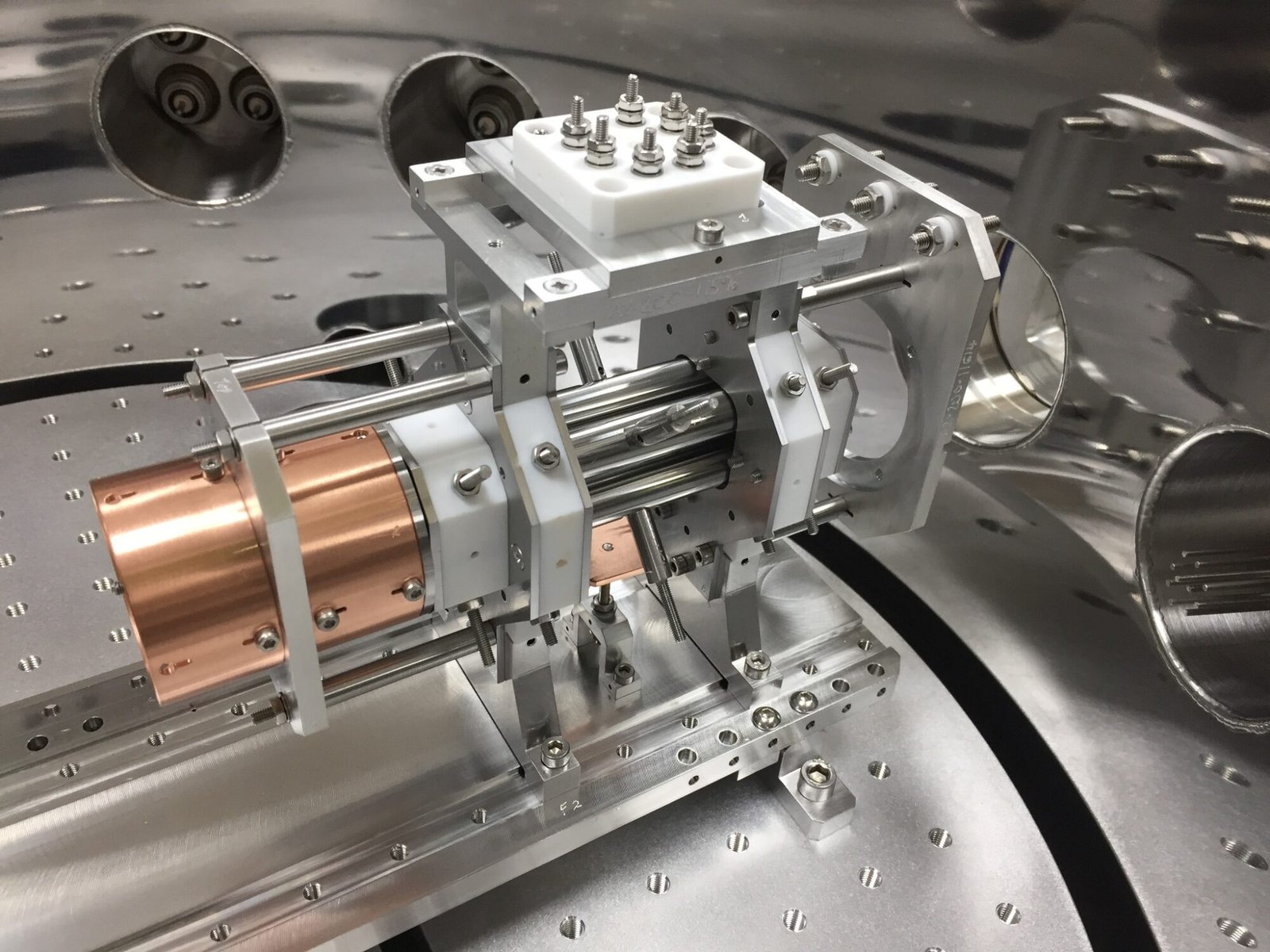
Tag: Analytical Chemistry & Measurement

  • Review of reaction control in radiofrequency ion traps

    Review of reaction control in radiofrequency ion traps

    What the study found

    The review concludes that radiofrequency ion traps offer a high degree of control over ion-molecule reaction dynamics. It summarizes ways to control internal quantum states, collision energies, and molecular structure in these systems.

    Why the authors say this matters

    The authors suggest that this control is relevant for studying quantum-state-dependent kinetics, quantum resonance effects, and structure-sensitive reactivity in ion-neutral collisions. They also conclude that it points to future work on full state-to-state reaction mapping, the ultracold quantum regime, and complex and chiral systems.

    What the researchers tested

    This is a review article, not an original experiment. The authors summarize prior techniques for trapping and cooling atomic and molecular ions, including Doppler and resolved-sideband laser cooling, sympathetic cooling, and cryogenic buffer-gas methods.

    What worked and what didn't

    The review describes several strategies that have been used to control reactions: internal cooling, optical pumping, state-selective photoionization, quantum logic spectroscopy, micromotion control, dynamic trapping, combination with molecular beams, isotopic substitution, conformational separation, and isomer-specific ion generation. It also notes applications in studies of quantum-state-dependent kinetics, quantum resonance effects, and structure-sensitive reactivity.

    What to keep in mind

    The article is a review, so its content depends on previously published studies rather than a single new experiment. The abstract does not describe specific quantitative results or detailed limitations beyond noting future challenges such as eliminating micromotion and reaching the ultracold quantum regime.

    • Radiofrequency ion traps are presented as a platform for controlling ion-molecule reaction dynamics.
    • The review covers trapping and cooling methods such as Doppler cooling, resolved-sideband laser cooling, sympathetic cooling, and cryogenic buffer-gas methods.
    • The authors describe ways to control reaction parameters through internal quantum states, collision energies, and molecular structure.
    • Applications discussed include quantum-state-dependent kinetics, quantum resonance effects, and structure-sensitive reactivity.
    • Future challenges include full state-to-state reaction mapping and reaching the ultracold quantum regime without micromotion.
  • Miniaturized extraction selectively enriches low-alkylated mineral oil aromatics

    What the study found

    The study found that a miniaturized liquid-liquid extraction (LLE) procedure can selectively separate and enrich non- and low-alkylated aromatic compounds from complex mineral oil mixtures. The authors report that this approach helps isolate the mineral oil aromatic hydrocarbon fraction most associated with toxicological concern.

    Why the authors say this matters

    The authors say this matters because mineral oil aromatic hydrocarbons (MOAH) can include genotoxic and carcinogenic species, especially polycyclic aromatic hydrocarbons (PAHs, aromatic compounds with multiple fused rings) with three or more rings and low alkylation. The study suggests the method may improve characterization of these toxicologically relevant fractions by reducing chromatographic masking.

    What the researchers tested

    The researchers tested a miniaturized LLE protocol with a double first extraction using dimethylformamide (DMF) and water in a 9:1 volume ratio, followed by back extraction with hexane after dilution with 4% NaCl solution. They evaluated the method with PAH standard mixtures and model mineral oil mixtures, including comparisons involving mineral oil saturated hydrocarbons (MOSH, saturated hydrocarbons in mineral oils).

    What worked and what didn't

    The method transferred non- and low-alkylated aromatics, including most PAHs with three or more rings, into the back extract, while highly alkylated mono- and di-aromatic hydrocarbons stayed mainly in the first extract. The authors report an average cumulative recovery of about 92% for PAHs with three or more rings and almost quantitative retention of MOSH in the first extract (96.7% ± 3.3%). They also report reduced co-transfer of squalene and highly alkylated MOAH interferences.

    What to keep in mind

    The available summary does not describe major limitations beyond the method being evaluated on standard mixtures and model mineral oil mixtures. The abstract does not provide details on performance across all possible mineral oil samples or on comparison limits relative to other analytical methods.

    • A miniaturized liquid-liquid extraction method selectively enriched non- and low-alkylated aromatics from mineral oil mixtures.
    • Most PAHs with three or more rings were transferred to the back extract, with about 92% average cumulative recovery.
    • Highly alkylated mono- and di-aromatic hydrocarbons were mostly kept in the first extract.
    • MOSH were almost quantitatively retained in the first extract, at 96.7% ± 3.3%.
    • The method reduced interference from squalene and other highly alkylated MOAH compounds.
  • Ultrathin chiral nanosheets improved gas chromatography separation

    What the study found

    The study found that ultrathin chiral two-dimensional nanosheets made from BPDS-PBIM showed exceptional separation performance in high-resolution gas chromatography. The reported material was a chiral ionic organic single crystal built from 4,4′-biphenyldisulfonic acid and a chiral ionic liquid.

    Why the authors say this matters

    The authors conclude that BPDS-PBIM has strong potential as a chiral stationary phase, meaning a chromatography material used to separate left- and right-handed forms of molecules. They also suggest broad application prospects in pharmaceutical analysis, flavor and fragrance quality control, and chemical reaction monitoring.

    What the researchers tested

    The researchers created BPDS-PBIM by ionic self-assembly of 4,4′-biphenyldisulfonic acid and the chiral ionic liquid PBIM. They confirmed its supramolecular environment and molecular packing with single-crystal X-ray diffraction, then exfoliated it into two-dimensional nanosheets and tested it as a stationary phase in gas chromatography.

    What worked and what didn't

    The exfoliated BPDS-PBIM nanosheets performed exceptionally well for separating several complex pharmaceutical molecules, including ibuprofen, ketoprofen, flurbiprofen, fenoprofen, and mexiletine hydrochloride. The abstract also says they separated chiral compounds with different polarity, but it does not give comparison data or describe any cases where the material did not work well.

    What to keep in mind

    The available summary does not provide numerical performance values, experimental conditions, or direct comparisons with other stationary phases. It also does not describe specific limitations beyond noting that developing chiral stationary phases with both structural stability and high enantioselectivity remains a challenge in this field.

    • BPDS-PBIM nanosheets showed exceptional separation performance in gas chromatography.
    • The material was made by ionic self-assembly of 4,4′-biphenyldisulfonic acid and a chiral ionic liquid.
    • Single-crystal X-ray diffraction confirmed a distinct supramolecular environment and molecular packing pattern.
    • The nanosheets separated several pharmaceutical compounds, including ibuprofen and ketoprofen.
    • The authors suggest potential use in pharmaceutical analysis, flavor and fragrance quality control, and reaction monitoring.
  • Validated HPLC method quantified clofazimine and pyrazinamide

    What the study found

    The study found that a reversed-phase high-performance liquid chromatography method with diode-array detection (RP-DAD-HPLC) was developed and validated for measuring clofazimine and pyrazinamide in a fixed-dose combination topical drug delivery system. The method was designed to separate and quantify both drugs in one analytical procedure.

    Why the authors say this matters

    The authors state that reversed-phase high-performance liquid chromatography is widely used in pharmaceutical development and quality control, and that adding diode-array detection improves selectivity when testing drugs with different chemical properties in the same dosage form. The study suggests this is relevant for finished pharmaceutical products and fixed-dose combination products.

    What the researchers tested

    The researchers developed an RP-DAD-HPLC method using a C18 column, gradient elution, 0.1% aqueous formic acid and acetonitrile as mobile phases, and detection at 254 nm for pyrazinamide and 284 nm for clofazimine. They validated the method according to ICH Q2 guidelines and assessed specificity, linearity, repeatability, intermediate precision, and robustness.

    What worked and what didn't

    The method showed linearity from 7.8 to 500.0 µg/mL with an r2 value of 0.9999. Reported precision was good, with system repeatability of %RSD ≤ 2.7% and intermediate precision of %RSD ≤ 0.85%. Robustness was evaluated with a three-level Box–Behnken design and response surface methodology, but the abstract does not report any specific robustness outcomes or failures.

    What to keep in mind

    The available summary does not provide detailed numerical results for specificity or robustness beyond the validation approach. It also does not describe performance in real product samples beyond stating that the method was intended for inclusion in a fixed-dose combination topical drug delivery system.

    • An RP-DAD-HPLC method was developed for clofazimine and pyrazinamide.
    • The method was validated under ICH Q2 guidelines.
    • Linearity was reported from 7.8 to 500.0 µg/mL with r2 = 0.9999.
    • System repeatability was %RSD ≤ 2.7%, and intermediate precision was %RSD ≤ 0.85%.
    • Robustness was tested using a Box–Behnken design and response surface methodology.
  • NHS ester derivatization performed best for amino acid LC-MS

    What the study found

    The study found that NHS ester-based derivatization agents were the most stable and effective among the agents tested for amino acid analysis by LC-MS. In particular, the NHS ester of isoquinoline-6-carboxylic acid (6-CiQ-NHS) performed best overall.

    Why the authors say this matters

    The authors conclude that 6-CiQ-NHS is a practical derivatization approach for amino acid quantification. The study also suggests that the results provide a framework for the rational design of future derivatization agents.

    What the researchers tested

    The researchers systematically evaluated derivatization agents built from pyridine, quinoline, and isoquinoline positional isomer scaffolds with three reactive groups: carbonyl chloride (COCl), sulfonyl chloride (SO2Cl), and NHS ester. They used deuterium-labeled amino acids to assess stability, derivatization efficiency, chromatographic behavior, and mass spectrometry (MS) response.

    What worked and what didn't

    NHS ester-based agents were reported to maintain activity for more than one year, showing better stability than the other reactive groups. Carbonyl chlorides and sulfonyl chloride-based agents were highly reactive but less stable. 6-CiQ-NHS combined rapid derivatization, a strong MS signal, excellent linearity (R2 ≥ 0.995), low nanomolar detection limits (0.23–6.33 nM), and separation of isomeric amino acids such as isoleucine and leucine.

    What to keep in mind

    The abstract does not describe specific experimental limitations beyond the comparison of the tested agents. The findings are limited to the derivatization agents and amino acid LC-MS conditions examined in this study.

    • The study compared pyridine, quinoline, and isoquinoline-based derivatization agents for amino acid LC-MS analysis.
    • NHS ester-based agents were more stable than carbonyl chloride and sulfonyl chloride-based agents.
    • 6-CiQ-NHS was identified as the most effective agent in the set tested.
    • The method showed low nanomolar detection limits and strong linearity.
    • The approach separated some isomeric amino acids, including isoleucine and leucine.
  • HPLC method measures caffeine, eugenol, and zingerone in green tea

    What the study found

    The study found that a reverse-phase high-performance liquid chromatography (RP-HPLC) method could be developed and validated to measure caffeine, eugenol, and zingerone together in a marketed Ashwagandha Green Tea formulation. The authors describe the method as simple, precise, specific, and robust.

    Why the authors say this matters

    The authors conclude that the method is suitable for standardising these three phytoconstituents, meaning plant-derived chemical compounds, in a commercial formulation. They also state that design of experiments was applied to robustness, which the study presents as part of integrating experiment-planning methods with RP-HPLC.

    What the researchers tested

    The researchers developed and validated an RP-HPLC method using a C-18 column and a methanol-water mobile phase in a 35:65 volume ratio. Detection and quantification were carried out at 254 nm for caffeine, eugenol, and zingerone, and the method was validated according to ICH guidelines.

    What worked and what didn't

    The reported retention times were 4.76 minutes for caffeine, 8.64 minutes for eugenol, and 10.48 minutes for zingerone. The method was validated for linearity, precision, specificity, limit of detection, limit of quantification, accuracy, and robustness, and the calibration plots showed a satisfactory linear relationship in the tested ranges. No failed measurements or negative results are described in the abstract.

    What to keep in mind

    The summary provided is limited to the abstract, so only the authors' reported validation outcomes are available here. The abstract does not give detailed numerical validation values, full experimental conditions, or limitations beyond the scope of the marketed formulation studied.

    • A validated RP-HPLC method was developed for simultaneous estimation of caffeine, eugenol, and zingerone.
    • The method was applied to a marketed Ashwagandha Green Tea formulation.
    • Detection and quantification were done at 254 nm using a C-18 column and methanol-water mobile phase.
    • Reported retention times were 4.76, 8.64, and 10.48 minutes for caffeine, eugenol, and zingerone.
    • The abstract says the method was simple, precise, specific, and robust.
  • RFS column mode improved separation efficiency and reduced analysis time

    What the study found

    The study found that a column operated in radial flow stream splitting mode can improve separation efficiency while maintaining quantitative accuracy and repeatability. It also reduced backpressure and shortened analysis time in testing of over-the-counter drugs.

    Why the authors say this matters

    The authors suggest the approach matters because ultra-/high-performance liquid chromatography is widely used for impurity profiling, active pharmaceutical ingredient quantification, and degradation product analysis, but higher flow rates are often limited by pressure. They conclude that the new mode may help support faster, high-resolution separations without adding the same pressure burden.

    What the researchers tested

    The researchers evaluated a novel column technology designed to enable high-resolution separations at reduced pressures and increased flow rates. They compared radial flow stream splitting mode with conventional stock mode and used it to assay over-the-counter medication, with quantitative performance assessed alongside separation and pressure metrics.

    What worked and what didn't

    In the reported tests, radial flow stream splitting mode achieved up to a 120% improvement in separation efficiency and a 30% reduction in backpressure compared with conventional operation. The abstract says there was no difference in quantitative reliability between radial flow stream splitting mode and stock mode, and analysis time was reduced by up to 40%.

    What to keep in mind

    The available summary does not describe detailed limitations, sample size, or the range of over-the-counter drugs tested. The findings are reported for the specific column technology and conditions described in the abstract.

    • Radial flow stream splitting mode improved separation efficiency by up to 120%.
    • Backpressure was reduced by 30% compared with conventional operation.
    • Analysis time for over-the-counter drug assays was reduced by up to 40%.
    • The abstract reports no difference in quantitative reliability between radial flow stream splitting mode and stock mode.
    • The study frames the method as relevant to high-performance liquid chromatography, where pressure can limit higher flow rates.
  • Light-controlled cellulose sorbent enabled amphetamine extraction

    What the study found

    The study found that an azobenzene-grafted cellulose sorbent called Cell-Azo could bind amphetamine and release it when exposed to light. The authors report that the material showed reversible light-driven switching and could be used for solid-phase extraction of amphetamine.

    Why the authors say this matters

    The authors conclude that Cell-Azo may be an efficient, green, and controllable alternative for trace amphetamine analysis in complex samples. They present the light-controlled release as the key feature that enables this use.

    What the researchers tested

    The researchers made Cell-Azo by grafting azobenzene onto cellulose through atom-transfer radical polymerization. They verified the material with FT-IR, XPS, and UV-vis spectroscopy, then tested adsorption behavior, light-triggered release, and a dispersive solid-phase extraction method coupled with HPLC-UV.

    What worked and what didn't

    The sorbent reached a maximum adsorption capacity of 19.86 mg per g at pH 9.0. UV light triggered amphetamine release with 90.54% desorption efficiency, while less than 35% desorbed in the dark. The analytical method showed linearity from 0.05 to 2.00 mg per L, a limit of detection of 7 micrograms per L, a limit of quantification of 23.33 micrograms per L, and precision with RSD below 5.1%; in spiked urine, recoveries were 69.53-75.68%.

    What to keep in mind

    The abstract does not describe detailed limitations beyond the reported performance in spiked urine samples. The results are based on the specific analyte amphetamine and the conditions tested in this study.

    • Cell-Azo is a cellulose-based sorbent modified with azobenzene.
    • Light exposure switched the material between binding and release of amphetamine.
    • The maximum adsorption capacity was 19.86 mg per g at pH 9.0.
    • UV light produced 90.54% desorption efficiency, compared with less than 35% in the dark.
    • The HPLC-UV method showed a detection limit of 7 micrograms per L and recoveries of 69.53-75.68% in spiked urine.
  • Interlaboratory validation supports PS80 measurement in therapeutic mAbs

    What the study found

    The study found that a high-performance liquid chromatography (HPLC) method with an evaporative light scattering detector (ELSD) can accurately measure polysorbate 80 in therapeutic monoclonal antibodies. It was validated across multiple laboratories and with different immunoglobulin G (IgG) monoclonal antibody samples and polysorbate 80 sources.

    Why the authors say this matters

    The authors conclude that this method can be recommended for release and quality control of polysorbate 80 concentration in therapeutic monoclonal antibodies. The study suggests this is relevant because polysorbate 80 is used to prevent aggregation and stabilize these drug products.

    What the researchers tested

    The researchers developed an HPLC method using ELSD for multiproduct analysis of polysorbate 80. They then validated it in several laboratories using different instruments and ELSD detectors, and tested it with various IgG monoclonal antibodies and different polysorbate 80 sources.

    What worked and what didn't

    The method was reported to accurately measure polysorbate 80 concentrations from 0.05 to 0.5 mg/mL. Robustness testing showed tolerance of up to 160 mg/mL monoclonal antibody interference, either by sample dilution or protein precipitation.

    What to keep in mind

    The abstract does not describe specific limitations beyond noting that other published methods exist and have their own limitations. No additional caveats are given in the provided summary.

    • A validated HPLC-ELSD method was developed for polysorbate 80 analysis.
    • Validation was done across multiple laboratories with different instruments and detectors.
    • The method measured polysorbate 80 accurately from 0.05 to 0.5 mg/mL.
    • It tolerated up to 160 mg/mL monoclonal antibody interference.
    • The authors recommend it for release and quality control testing.